Thursday, 31 May 2012

Patience is a Virtue

Sorry I haven't blogged as much lately, but one of our employees recently had a child and Google sending out so many warning messages in webmaster central has created a ton of demand for independent SEO advice. Our growth in demand last month was higher than any month outside of the time a few years ago when we announced we would be raising prices and got so many new subscribers that I had to close down the ability to sign up for about 3 or 4 months because there were so many new customers.

Google has been firing on all cylinders this year. They did have a few snafus in the press, but those didn't have any noticeable impact on user perception or behavior & Google recently rolled out yet another billion Dollar business in their consumer surveys.

Google is doing an excellent job of adding friction to SEO & managing its perception to make it appear less stable, less trustworthy and to discourage investment in SEO. They send out warnings for unnatural links, warnings for traffic drops, and even warnings for traffic increases.

Webmaster Tools is a bit of a strange bird...

  • Any SEO consultant who has client sites tied into Webmaster Tools makes it easy to connect them together (making any black swan editorial decisions far riskier).
  • Any SEO company which has clients sign up for their own Webmaster Tools account now has to deal with explaining why things change, when many of the changes that happen are more driven by algorthmic shifts (adding local results to the SERPs or taking them away, other forms of localization, changing of ad placement on the SERP, etc.) than by the work of the SEO. This in turn adds costs to managing SEO projects while also making them seem less stable (even outside of those who were use paid link networks). Think through the sequence...
    • Google first sends a warning for traffic going up, and the SEO tells the client that this is because they did such a great job with SEO.
    • Then Google sends a warning for traffic dropping & the client worries that something is wrong.
    • The net impact on actual traffic or conversions could be a 0, but the warnings amplify the perception of changes.
  • Any SEO who doesn't use Webmaster Tools loses search referral data. It first started with logged in Google users, but apparently it is also headed to Firefox. Who's to say Google Chrome & Safari won't follow Firefox at some point?

Google has changed & obfuscated so many things that it is very hard to isolate cause and effect. They have made changes to how much data you get, changes to their analytics interface & how they report unique visitors, changes to how tightly they filter certain link behaviors, they have rolled in frequent Panda updates, and they have nailed a number of the paid link networks.

BuildMyRank shut down after leaving a self-destructive footprint that made it easy for Google to nuke their network, and some of the remaining paid link networks are getting nailed. Some of their customers are at this point driven primarily by fear, counting down their remaining days as the sky is falling. Fear is an important emotion designed to protect us, but when it is a primary driver we risk self-destruction.

The big winners in these moves by Google are:

  • Google, since they grant themselves more editorial leeway. If everyone is a scofflaw then they can hit just about anyone they want. And the organic search results are going to be far easier to police if many market participants are held back by a fear tax.
  • Larger businesses which are harder to justify hitting & which can buy out smaller businesses at lower multiples based on the perception of fear.
  • Sites which were outranked by people using the obvious paid links, which now rank a bit better after some of those paid link buyers were removed from the search results.
  • SEOs who out others & market themselves by using polarizing commentary (at least in the short run, whereas in the long run that may backfire).
  • Those engaging in negative SEO, which sell services to smoke competitors.

The big losers from these Google moves are:

  • some of the paid link networks & those who used them for years
  • under-priced SEO service providers who were only able to make the model work by scaling up on risk
  • smaller businesses who are not particularly spammy, but are so paralyzed by fear that they won't put in enough effort & investment to compete in the marketplace

One of the reasons I haven't advocated using the paid link networks is I was afraid of putting the associated keywords into a hopper of automated competition that I would then have to compete against year after year. Even if you usually win, over the course of years you can still lose a lot of money by promoting the creation of disposable, automated & scalable competing sites. If you don't mind projects getting hit & starting over the ROI on such efforts might work out, but after so many years in the industry the idea of starting over again and again as sites get hit is less appealing.

It is not just that the links are not trusted, but now they stand a far greater chance of causing penalties:

Dear site owner or webmaster of ?.

We?ve detected that some of your site?s pages may be using techniques that are outside Google?s Webmaster Guidelines.

Specifically, look for possibly artificial or unnatural links pointing to your site that could be intended to manipulate PageRank. Examples of unnatural linking could include buying links to pass PageRank or participating in link schemes.

We encourage you to make changes to your site so that it meets our quality guidelines. Once you?ve made these changes, please submit your site for reconsideration in Google?s search results.

If you find unnatural links to your site that you are unable to control or remove, please provide the details in your reconsideration request.

If you have any questions about how to resolve this issue, please see our Webmaster Help Forum for support.

Sincerely,

Google Search Quality Team

If that doesn't change then negative SEO will become a bigger issue than paid links ever were.
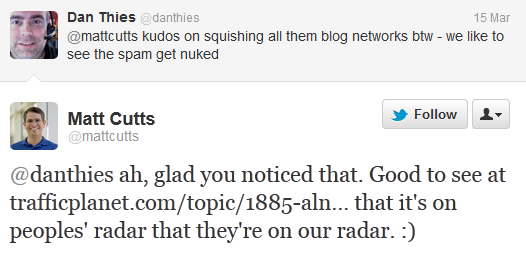
What is hard about Google penalizing websites for such links is that it is cheap & easy for someone else to set you up. Shortly after Dan Thies mentioned that it was "about time" to Matt Cutts on Twitter someone started throwing some of the splog links at his site. It is safe to say that Dan didn't build those links, but there are many people who will be in the same situation as Dan who did nothing wrong but had a competitor set them up.

And there is no easy way to disconnect your site from those types of links.

If you go back a few years, it was quite easy to win at SEO by doing it in a "paint by number" fashion. One rarely got hit unless they were exceptionally excessive and stuck out like a sore thumb.

But after all of Google's recent moves, a few missed steps in a drunken stupor can have the same result.

Now more than ever, patience is a virtue!

Categories: 

Source: http://feedproxy.google.com/~r/seobook/seobook/~3/x5N04W7JvTU/patience

how to whiten teeth how to whiten teeth at home

Kindle fire coupon 2011 ? (Save for you 10 ? 40%)

Looking for the Kindle fire coupon to get the best deals and sales on the well-known Kindle fire tabletr? There are many reasons why the Amazon�Kindle fire has become increasingly popular these days. You might be taking into consideration the distinction between the Kindle and the Nook Color if you’re among those looking for an [...]

Source: http://homemadechristmasgift.org/2011/11/kindle-fire-coupon-2011-save-for-you-10-40/

how to whiten teeth at home how to whiten teeth

Wednesday, 30 May 2012

Whitespark's Local Citation Finder Review

Local citations are a critical part of a local SEO campaign. In looking at David Mihm's Local Search Ranking Factors you can see that a majority of the top 10 factors focus on business information structure and links. Half of the top ten factors relate to items which local citations can help with:

  • Physical Address in City of Search
  • Crawlable Address Matching Place Page Address
  • Volume of Traditional Structured Citations (IYPs, Data Aggregators)
  • Quality of Inbound Links to Website
  • Crawlable Phone Number Matching Place Page Phone Number

Making local citation building a part of your local SEO campaign has more benefits than simply "building citations". Think of all the ways it can help with both local search (see factors above) and web search in general:

  • Many of the better citation sources are actually good links (for your domain in general), from diverse domains
  • A good amount of folks searching locally are likely to use apps for searches in addition to Google (you want to make sure you are listed in as many places as possible)
  • Ensuring that your business data is structured in a similar way across the web helps with client communication and Google Places
  • Building citations naturally leads to other business enhancing activities you can offer your clients; things like helping them get their clients to leave positive reviews and provide helpful feedback to the company post-sale
  • A potential client is likely to do research on your or your client's business before they buy. Being represented, in a good way, across the web helps the company's reputation and clout with potential customers

Citation building can be tedious on multiple fronts. Finding quality citations that you do not currently have, comparing citation profiles (yours and your competitor's), and actually building the citations as well as following up on them.

Whitespark takes care of the first two, searching and comparing, quite well and provides the framework for building citations efficiently. Whitespark can also rerun your search queries to check on whether your citation has been completed or not.

Whitespark Pricing

Whitespark has 5 plans:

  • Free
  • 20$ per month - 20 searches per day, 5 projects, unlimited citations per search, comparison tool, monitoring tool, CSV export options
  • 30$ per month - 30 searches per day, 10 projects, and all the features of the 20$ plan
  • 40$ per month - 40 searches per day, 20 projects, same features as above
  • 100$ per month, 100 searches per day, unlimited projects, same features as above

I like how the pricing scales with projects and searches. The pricing is a great value for anyone doing local SEO at scale and there are options to support any size agency.

Setting Up a Project

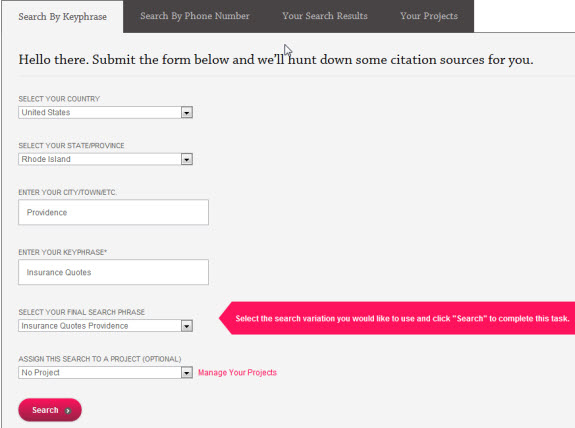
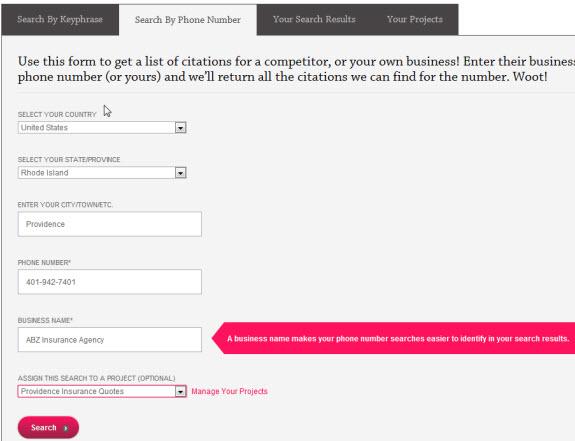
When you first get inside the tool you'll be able to set up a search straight away. You'll be able to select the following:

  • Country (Whitespark supports over 30)
  • State/Province
  • City or Town (they pull from a database, when you start typing you'll be able to select your desired location)
  • Keyphrase (just the keyword)
  • A drop down to select your preferred search phrase
  • Project Assignment or Creation

Here, I've started a query for insurance quotes in Providence, Rhode Island

When you select state and city/town it sets the location inside of Google. However, sometimes you do need to add the state or state abbreviation to the query to get the best results (in my experience).

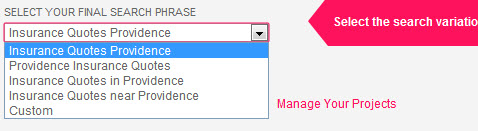
You have options on the final keyphrase. The dropdown, seen below, gives you the option to broaden the area, rearrange the order of the query, or create a custom query:

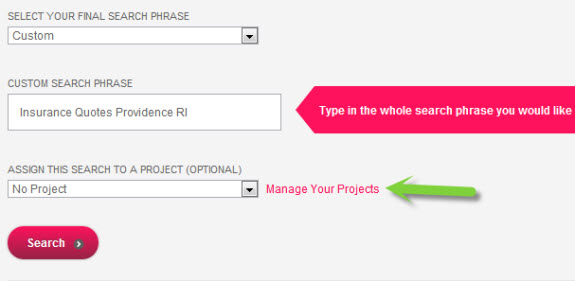
Once you click on that, you can add whatever query you want. In this case, based on my experience, I just added "RI" to the end of the query to help with hyper-local targeting.

Next up is the project creation (or addition). I haven't created a project to store this query in, but it's super easy to do from this page. Click on "Manage Projects" and you'll be able to create a new one:

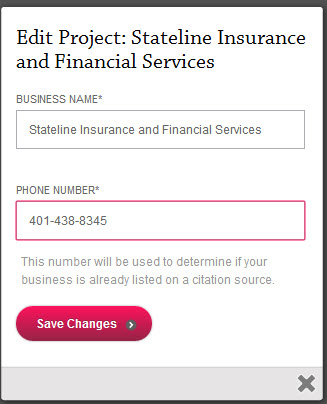
You are then brought to the create project page. You can name your project and add your phone number (I added one for an agency ranking organically for the term) to check current citations.

*Important* - The formatting of the number is important. You should use (401) 438-8345 or 401-438-8345 as 4014388345 results in far fewer results than properly formatted numbers.

You should add the business name (yours or your client's) as the project name for more accurate citation mapping.

Now just go back and add that query to that particular project on the Search by Keyphrase Page and you are good to go. The tool will email you when the results are ready.

Ideally, you'll want to have a seed list of terms to start out with so you can check your results versus your competitions across your most important local terms. So for an insurance agency I might go with:

  • Auto Insurance Providence RI
  • Life Insurance Providence RI
  • Insurance Agent in Providence Ri

In a perfect world you'd want to do some keyword research on these terms, look at keywords your competition might be ranking for, look at the site's current analytics and PPC data (if available), and so on in order to find the best keywords to target.

Search by Phone Number

While we are waiting for those results to come back, let's talk about the search by phone number option. This is a great way of checking your own citations or that of a competitor, or even a prospective client (especially if their citations are a mess or missing).

So I added a competitor, their phone number and saved it to my project. Very simple, very straightforward. We'll let that run and circle back to it once the report is ready.

Working with the Data

It took about 3 minutes for our first query to complete :)

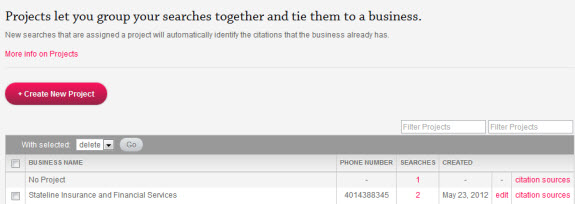
You can go back to your project and view all the searches assigned to it:

From here you can edit the name and phone number of the project, view the searches (I have the 1 keyword phrase search and the competitor phone number search) assigned to the project, and just view the citation opportunities for the business without the competitor information.

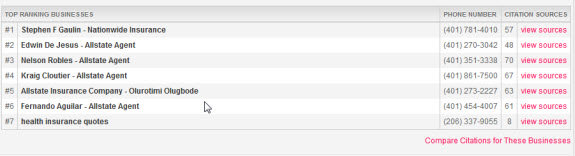
There are 2 components to a keywords search report. The first piece displays the top ranking (in places/maps) sites for the query. It allows you to see the total citations for each site and offers links to view specific sources for each site as well as a comparison of those sites:

You can view sources for each competitor or compare them against each other for total citation counts.

The second piece of the report are the actual citation sources. The citation sources have the following data points:

  • Site (the citation url)
  • Link to the submission page, if available
  • OC - number of times the citation source appeared in the SERP during the searches (higher counts are good indicators of domain authority)
  • Discovery - date the citation source was discovered
  • Site Type - the type of site (still in beta), could be social, directory, news, etc
  • AC - Majestic SEO's AC Rank
  • DA - SeoMoz's Domain Authority
  • Got It (checkbox) - used for when a citation is acquired
  • Useless - used when a citation source is not applicable or undesired

All columns are sortable, making it easy to manipulate the data however you'd like to spot the best opportunities.

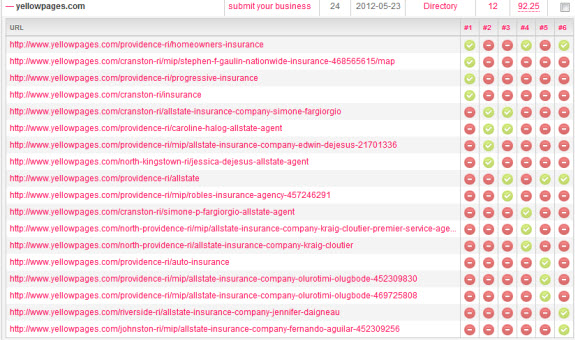
When you view the report that includes the competition, you can click the plus sign to expand the URL of the citation source for more specific data:

You'll be able to see a spread of co-occurring citations on specific pages. This can be useful in spotting category listing opportunities on specific citation sources (for example, being listed on YellowPages.Com/Providence-RI/Homeowners-Insurance as well as your own listing).

If you have associated the search with a project, then for citations that already were acquired before the search was run, you'll see them as highlighted in green with the "got it" check box already checked:

When you check off one as "useless" it simply gets grayed out.

A cool feature here is that already acquired (citations found by Whitespark and citations checked off by you) carry across other searches in your project. At any point you can come back to the search and re-run it (after a citation building campaign is always a good time) to see the status of your citation profile.

Also, when you export the list it exports (2 options) the following criteria:

(Choosing Export as CSV)

  • Root Citation URL
  • SERP Appearance Count
  • AC Rank
  • Domain Authority
  • Submission URL (if available)
  • Got It and Useless check marks

If you choose "Export CSV (w/URLs) you get all of the above plus the url's of the actual citations.

Choosing the first option makes it incredible easy to hand off to a citation builder.

Darren's Pro Tips

I always like to go directly to the creator of a tool to get their thoughts and tips. Darren was gracious enough to provide his insights for us (see below):

The local citation finder has two main citation search capabilities:

  1. Search by keyword and the tool will find all the top ranking businesses, then find their citations, and present them in a big list for you.
  2. Search by phone number, and the tool will find the list of citations for that particular business. Use this to find your own citations, or a specific competitor's citations.

We use the data in three ways:

  • Use it to find places where your competitors are listed, but you're not, and then get listed in those places.
  • Use it as a competitive analysis tool to identify where the competition is getting citations. This extends beyond basic business directories as the tool will reveal competitor's citations from local blogs, newspapers, event listings, job sites, business partners, etc. Looking at their strategies will give you ideas for creative citation building tactics you can employ in your practice.
  • Use it to find citation sources focused on the city, or the industry

I think the best way to look at the tool is as competitive analysis. You run a keyword search, see who's rankings, then get a big list of all the citations they collectively have. You can click the "compare citations for this business" link to see who's listed where.

A great little hidden feature of the tool is to do a phone number search for your business, plus a keyword search, then in the Your Search Results section, check off the two searches and choose "compare" from the dropdown at the top of the table. This will show you all the places where the competition is listed and you're not.

I also like to use the tool to find hyper-local citation opportunities. Here's how:

  1. Run a LOT of KW queries on the local citation finder in the city/niche and associate them all with a project. So, for a lawyer in chicago: chicago lawyer, lawyers, attorneys, dui lawyer, robbery lawyer, criminal lawyer, etc.
  2. Go under ?Your Projects? and ALL the citation sources from all the queries will be listed under ?view sources?. Ctrl-f in your browser for ?law?, ?legal?, ?chicago?, ?illinois?, etc.
  3. Any niche or location related terms. Copy all the domains that match the Ctrl-f searches into a spreadsheet. These are your hyper local citations.

We found that getting listed on sites that had the city or keyword in the domain provided a big boost in the local rankings. The more you can find, the better. You'll have to pick through the list to pull out actual directories, as many of the results will be businesses with the city or keyword in the domain, but it's worth it.

Thanks to Darren for the insight and for making Local SEO a bit easier :) Give Whitespark a try for your local SEO campaigns, I think you'll like it :)

Categories: 

Source: http://feedproxy.google.com/~r/seobook/seobook/~3/obejmPQZ54k/depth-review-whitesparks-local-citation-finder

how to whiten teeth how to whiten teeth at home

Tuesday, 29 May 2012

Maximizing Google Analytics Insight for SEO with Custom Reports

Google Analytics - one of the most powerful tools for any SEO, assuming you know how to get the data you need from it. One of my favorite things about Google Analytics is how many tools that put at your disposal for quickly analyzing the data you care most about. But again, that all assumes you know how to get it.

A custom report in Google Analytics is similar to their custom dashboard features in a lot of ways. Remember, the dashboards are meant as snapshots of what's going on with your campaign, these custom reports are what you should be using to fully analyze the results.

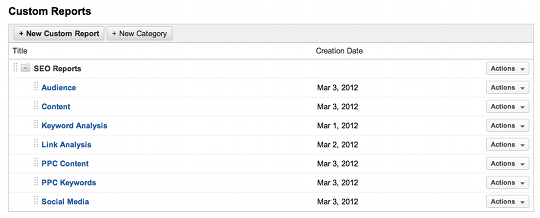
Custom Report Categories

To start, you should consider setting up Custom Report categories to organize your reports by subject. You will find this to be the most aggravating/irritating/infuriating part of the process as you attempt to drag your first custom report into your new category folder. The secret is to drag your report slightly to the right while hovering over the category you want to place it in. Then let go and hope for the best. Once you have one report in there it gets much easier.

Creating a Custom Report

There are two key components to a custom report:

  1. Metric: a numeric measurement (like number of visits).
  2. Dimension: a description of visits, visitors, pages, products and events.

There are also two types of Custom Reports you can create:

  1. Explorer: Allows you to drill down into sub-dimensions and includes a timeline where you can compare metrics in the same graph.
  2. Table: Allows you to compare dimensions side by side, with metrics also populated within the table. There is no timeline in this report.

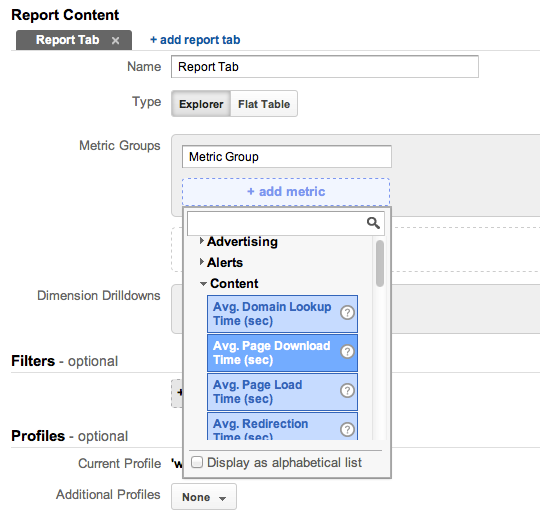
Creating the custom report is easy. You choose from a drop-down menu of metrics and dimensions that you're interested in segmenting your report by.

Creating a Custom Report

You can also create tabs in your report to keep it organized. Any filters you setup on one tab will automatically apply to any other tab that you setup (there isn't a way to turn them off for the other tabs).

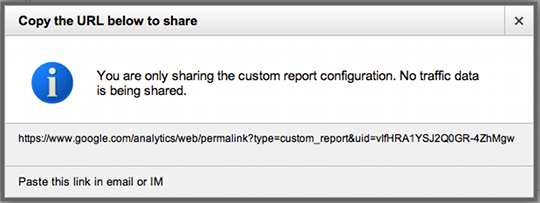
Another great feature of custom reports is your ability to use them cross-profile and to share them. To share a report, all you need to do is click the Actions drop-down menu from the Custom Reports overview page, and click share. You will then be able to share the configuration (not the data) of the custom report you just created.

Sharing Custom Reports

SEO Custom Report Examples

If you'd like to save time in your SEO analysis, consider creating custom reports similar to the ones outlined below. I've included the share link for each custom report so you don't have to rebuild it yourself. I tried to mix up when I'd tailor the report to look at e-commerce data, and when it would only look at goal data. You'll need to customize those aspects of the report to best meet your needs.

Also, don't forget to modify the keyword filters I've added. You want to make sure to replace our branded keyword (book) with your own.

Audience Custom Report

Understanding your audience's demographics is an often overlooked SEO practice, but it can go a long way in making certain aspects of SEO (like link building) that much easier.

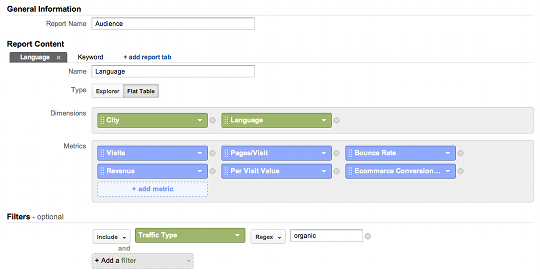
Audience Custom Report

There are two components to this custom report:

  1. City and Language Overview - this part of the report looks at what cities and languages you receive the most visits from and make the most money off of. You may be surprised to see languages your site isn't even translated in yet that are very profitable.
  2. Keyword Targeting - this part of the report lets you drill down all the way to the keywords that are used by each country and language visitor demographic, and calls out how profitable they are for you. This is a great way to refine your keyword targeting.

How this can help you from a link building front is seeing what foreign languages your blog/linkbait content is most popular in, and then translating it. You could then distribute the translated content for links to popular industry blogs in that language.

Add the Audience Custom Report to Google Analytics

Content Custom Report

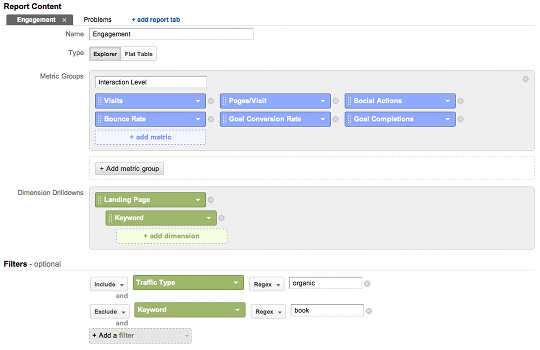
The purpose of the Content Custom Report is to identify which content is performing the best with organic traffic. I've set this report up as a Explorer Custom Report so you can drill down and see which keywords are sending traffic to a specific Landing Page. This is a great way to make sure you're targeting the right keywords on the right pages in your SEO campaign.

Content Custom Report

There are a number of engagement metrics I have this report looking at. One in particular I think is important to have with this report is the Social Actions metric. This is a great way to see if the number of social actions correlates with increases in traffic and conversions.

You might consider adding an additional filter (or creating a new custom report) that only looks at your blog content. I'd keep similar metrics in the report so you can quickly identify which blog posts perform the best so you can try and duplicate the results in future content. You may also want to add any event goals you've created to the report, especially if you've set up a event to track comments on your posts.

Add the Content Custom Report to Google Analytics

Keyword Analysis Custom Report

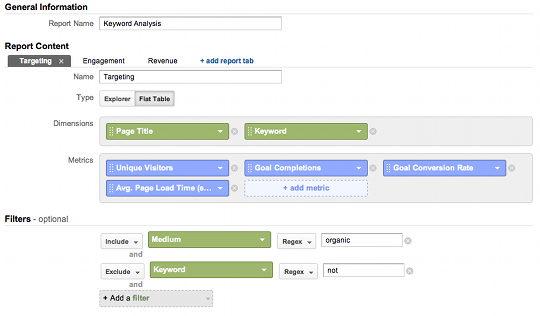
I think this is one of the most valuable custom reports you can run, and it's one of the bigger custom reports that I like to create in my accounts. There are three components to the report: targeting, engagement and revenue.

Keyword Analysis Custom Report

Targeting
This part of the report is pretty straight forward. It's a Flat Table report that places the Page Title and the Keyword that is sending it traffic side-by-side. From there I've added a handful of metrics to determine if I am targeting the right keyword on the right page. Perhaps I'm getting a lot of traffic for this particular keyword, but the majority of people are going elsewhere and/or not converting. This may lead me to do some testing around changing which page I'm optimizing for this particular keyword.

Engagement
Similar to the Content Custom Report, this component focuses on how engaging visitors are when they visit the site via a specific keyword. I love traffic just as much as the next guy, but if that traffic isn't doing anything on my site - what good is it? This report will help you identify problems and opportunities for keywords that have low/high engagement rates.

Revenue
Just how much money is a keyword making you? This component of the report looks at the number of transactions, the revenue generated and the per visit value of organic traffic for each keyword.

Add the Keyword Analysis Custom Report to Google Analytics

Link Analysis Custom Report

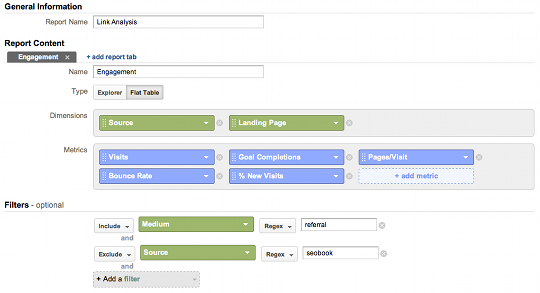
Which of the inbound links that you've built are sending you the most quality traffic? Don't forget, there's much more to links than rankings, they are also opportunities for sending high quality traffic to your site that may even convert.

This custom report looks at which of your referrals are sending you the most engaging traffic. Knowing which links are sending you the most quality traffic will help you determine if you should be going back for more or if you can find other sites just like it to get links set up on.

Link Analysis Custom Report

If you're investing a lot of time in getting specific links built, you may even consider tagging them with Google's URL builder tool. This will allow you to track the effectiveness of your link building campaign.

Add the Link Analysis Custom Report to Google Analytics

PPC Content Custom Report

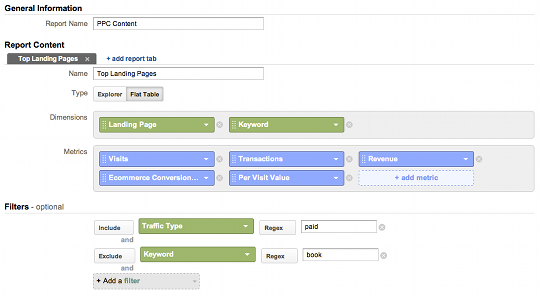
I'm a big fan of using paid search as a way to test which landing pages you want to target your keywords on for relevance. The goal of the test is to determine if you were to target a specific keyword on that page, would the visitor find what they are looking for and convert? This is a great way to minimize the risk of focusing on the wrong keyword on the wrong page and investing months of SEO work to get it traffic.

PPC Content Custom Report

You can use this custom report to look at just that: which keyword/landing page combinations are the most effective from a revenue perspective. Even if you don't run a test like the one I just described, you can still get a pretty good grasp on this just by pulling the report and looking for these opportunities.

Add the PPC Content Custom Report to Google Analytics

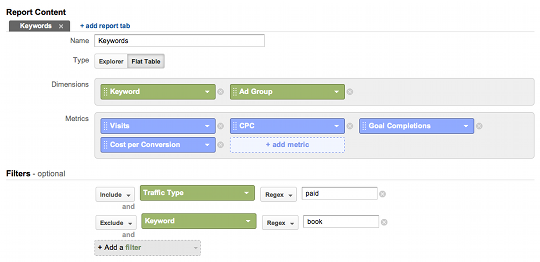
PPC Keywords Custom Report

Continuing with our holistic custom reports, the goal of the PPC keywords custom report is simple: identify high performing keywords from your paid search campaigns that you could consider targeting in your SEO campaign.

PPC Keywords Custom Report

The report calls out a couple qualifier metrics, including how much money bidding on the keyword is costing you, and what your cost per conversion is. This is a great way to decide if you can't afford to target the keyword via PPC, can you make up the loss of traffic via SEO?

Add the PPC Keywords Custom Report to Google Analytics

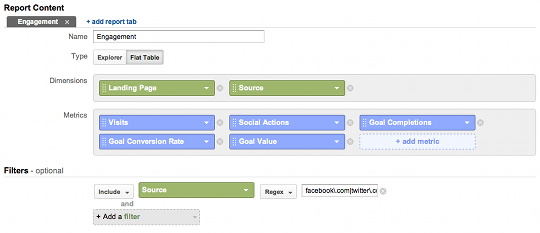
Social Media Custom Report

We've seen the influence social media has on SEO, and now it's time to make sure we're well-informed of any social media data that can be leveraged to improve our campaigns.

This report uses a filter created by Site Visibility to look at all referring traffic from a variety of top social sources. With this filter applied you can look at which social traffic is most engaged with your content.

Social Media Custom Report

If you're tracking social actions you can quickly see which content you've created is being shared the most, so you can figure out what they like about the content and duplicate the results.

I also like to see which social media is converting the best so I can determine if we should be increasing our participation efforts on that social network, or even start experimenting with advertising on that social network.

Add the Social Media Custom Report to Google Analytics

So there you have it, seven custom reports to help you analyze your analytics data faster and easier. What other SEO-focused custom reports have you found valuable?

Categories: 

Source: http://feedproxy.google.com/~r/seobook/seobook/~3/0l2xHFXNRnI/maximizing-google-analytics-insight-seo-custom-reports

how to whiten teeth how to whiten teeth at home

Tracking Micro Conversions with Event Tracking for Improving SEO Campaigns

Conversions. The one metric we all know we should be focusing on, and yet it's the one thing that gets overlooked the most. So many of us focus on just one main conversion point, and forget how many other types of visitor engagement exist on our sites. These other engagement points, or less-important conversions are what experts call "micro conversions."

World-renowned analytics expert Avinash Kaushik is a strong supporter of the use of micro conversions. In his Excellent Analytics Tip series, he explains the benefits of tracking both micro and macro conversions:

3. It will force you to understand the multiple persona's on your website, trust me that in of itself is worth a million bucks. It will encourage you to segment (my favorite activity) visitors and visits and behavior and outcomes. Success will be yours.

When you understand your various visitor personas, you can create better targeted content, value-adds and better messaging overall. This will only strengthen your SEO campaign and will help guide you to improving your conversion rate and the ROI of your SEO efforts.

Event Tracking in Google Analytics

One of my favorite ways to track micro conversions is with event tracking in Google Analytics. Before I walk you through how to setup events, let's first make sure we understand the difference between events and your traditional goals in Google Analytics.

In the past, a goal in Google Analytics was when any action a visitor would take on your site that took them to a confirmation page. When the visitor reached that confirmation page, Google Analytics would count it as a goal completion.

An event, on the other hand, is when a visitor takes action on your site and there is no confirmation page. A good example of this would be when someone clicks a "Follow Me on Twitter" link on your site. It takes the visitor off of your website and makes you unable to add conversion tracking code to their destination page (because it lives on Twitter.com).

In addition to bringing us cool features like custom dashboards, the new Google Analytics also made it much easier to track events as goals. Which is what we'll be focusing on today.

Setting Up an Event

Events are much easier to setup then you might imagine. All you need to do is add a little piece of customized code to the URL a visitor will be clicking on to trigger the event, and you're halfway there. Let's start with understanding what our event tracking options are.

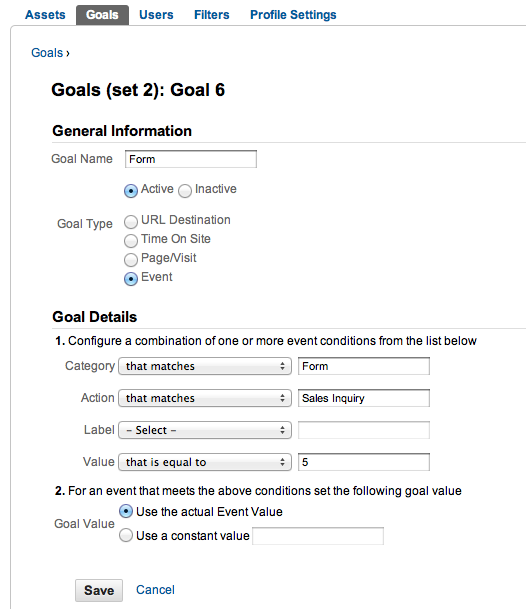
There are five fields in total that you can use to categorize your event, two of which are optional:

  • Category: The general name of the type of event you wish to track. If you'll be setting up events of a similar topic (like form submissions), you'll want to keep this consistent across all of the events you setup.
  • Action: A description of the action the visitor is taking to trigger the event. So if your category is set to "Forms", your action might be set to "Sales Inquiry".
  • Label: This is an optional field used to further describe the type of event. If you're tracking multiple forms of the same type (like contact forms), you may consider using this field to avoid any confusion with the other events.
  • Value: Suppose each micro conversion does have a monetary value of sorts for you, this is the field you'd use to track that numeric number.
  • Non-Interaction: A true/false field that you can use to prevent a visitor who completes the event and leaves your domain from being recorded as a bounce in Google Analytics

Still with me? Now here comes the fun part: building the event tracking script.

The framework of your event tracking script looks like this:

onClick="_gaq.push(['_trackEvent', 'Category', 'Action', 'Label', Value, false]);"

There are a couple of things you need to remember when you customize the various fields in the script (e.g. "Category"):

  • You must fill in the Category, Action and Non-Interaction fields
  • The Value and Non-Interaction fields do not have a single quote around around them like the others
  • If you choose to omit the Label or Value fields, also omit the single quote but not the comma that separates them from the other fields. In this example I've ommitted both fields, but not their commas:

  • onClick="_gaq.push(['_trackEvent', 'Category', 'Action',,, false]);"

  • The Non-Interaction field can only be set to true or false (remember: no quotes!)

Now that you've set up the script, you should place it within the href component of any link you are setting up. Here's an example of what it would look like:

<a href="http://twitter.com/seobook" onClick="_gaq.push(['_trackEvent', 'Category', 'Action', 'Label', Value, false]);">Follow us on Twitter!</a>

The final piece of the puzzle is adding the event as a goal in Google Analytics.

  1. Click the gear icon in the upper right corner of the Google Analytics profile you're setting up the goal in
  2. Using the sub-navigation where your Profile information is listed, select the Goals tab
  3. Choose the goal set you wish to add the event to (I like to categorize my goal sets)
  4. After you name your goal, select the Event radio button
  5. You now need to populate the event details exactly how you set them up in your script. If you omitted a field, just leave it blank

Event Tracking

You've now setup your event as a goal!

Types of SEO Micro Conversions

Now that the hard part is out of the way, let's brainstorm some micro conversions we could be tracking.

Social Engagement

You can use event tracking to track Share This links and blog comments. That way you can quickly see which content has the highest engagement so you can build more of it.

Affiliate Links and Ads

You may also wish to track when someone clicks one of your affiliate links or a banner you have on your site. This is a great opportunity to take advantage of the Value field so you can keep track of how much each of those clicks are worth (and perhaps double-check that you're getting paid the right amount).

Downloads

If your site has white papers, presentations, video, audio or any other type of file that users can download, you can easily keep track of those downloads with event tracking.

Follow Me/Like Us Links

If one of your macro conversion goals is brand awareness, you should consider adding an event whenever someone clicks a "follow me on Twitter" or "Like us on Facebook" link on your site. That way you can track back the source of those follows/likes to SEO.

Live Chats & Customer Support

Many service companies still utilize live chat to quickly address customer inquiries and problems. When someone clicks the live chat link, you can trigger an event to count it as a goal completion.

Additionally, if you use a third party customer support center, you can trigger an event whenever a user clicks the outbound links for those services.

These are just a few of the micro conversions you could be tracking on your site. While every site is different and is interested in tracking different things, hopefully this will give you a few ideas of additional conversion points you could be looking at to better understand your audience. The better we understand our visitors, the better job we can do as SEOs to attract more of them.

Categories: 

Source: http://feedproxy.google.com/~r/seobook/seobook/~3/HZsmiIU0Zm0/tracking-micro-conversions-with-event-tracking

how to whiten teeth at home how to whiten teeth

Monday, 28 May 2012

Kindle fire coupon codes ? Update for December 2011

Looking for the Kindle fire coupon codes to get the best deals and sales on the well-known Kindle fire tabletr? There are many reasons why the Amazon�Kindle fire has become increasingly popular these days. You might be taking into consideration the distinction between the Kindle and the Nook Color if you’re among those looking for [...]

Source: http://homemadechristmasgift.org/2011/11/kindle-fire-coupon-codes-update-for-december-2011/

how to whiten teeth how to whiten teeth at home

Sunday, 27 May 2012

Google AdWords Ads Add Album Cover & Song Preview

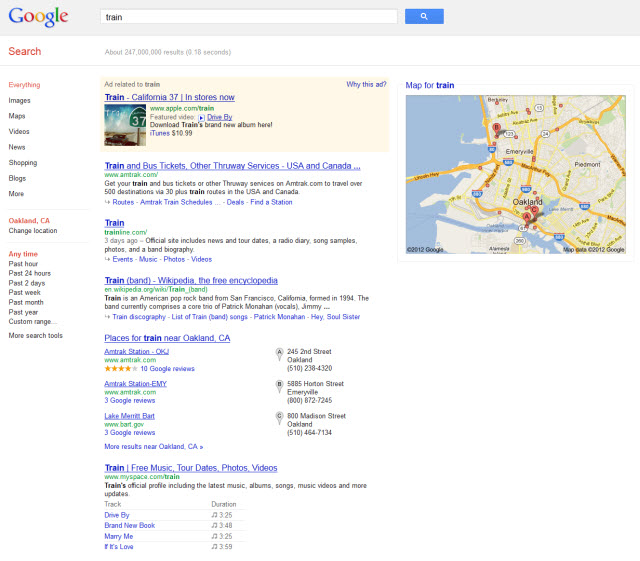
Before I get any drops of jupiter hate on the following...I was typing in training.seobook.com & somehow accidentally hit enter after typing train & when the URL completion didn't work I got the following SERP.

If you click the feature video link it does a YouTube video overlay. The other links lead into the relevant iTunes webpage.

Such media extensions have been in place for movies for quite a while now, but this is the first time I have seen them on music-related search results. In time one could expect similar ad expansions to hit other media areas like books, games, and maybe even other vertical search features. Google could possibly roll it out globally on brand searches as well at some point, allowing companies to offer intro videos (or even reviews of new product lines) directly in the search results.

Source: http://feedproxy.google.com/~r/seobook/seobook/~3/F_aczhM5L7Q/musical-adwords

how to whiten teeth at home how to whiten teeth

Kindle fire coupon 2011 ? (Save for you 10 ? 40%)

Looking for the Kindle fire coupon to get the best deals and sales on the well-known Kindle fire tabletr? There are many reasons why the Amazon�Kindle fire has become increasingly popular these days. You might be taking into consideration the distinction between the Kindle and the Nook Color if you’re among those looking for an [...]

Source: http://homemadechristmasgift.org/2011/11/kindle-fire-coupon-2011-save-for-you-10-40/

how to whiten teeth how to whiten teeth at home

Saturday, 26 May 2012

Kindle fire Coupon for Christmas Deals

Every years, Amazon have great sales about Christmas. Having a lot of Kindle fire coupon for Christmas, it is a great time for customers to go shopping. In 2012, people can buy a Kindle Fire Coupon with kindle fire tablet with the price only $169. Amazon can provide Kindle Fire Coupon for Christmas Day from [...]

Source: http://homemadechristmasgift.org/2011/12/kindle-fire-coupon-for-christmas-deals/

how to whiten teeth how to whiten teeth at home

Friday, 25 May 2012

Patience is a Virtue

Sorry I haven't blogged as much lately, but one of our employees recently had a child and Google sending out so many warning messages in webmaster central has created a ton of demand for independent SEO advice. Our growth in demand last month was higher than any month outside of the time a few years ago when we announced we would be raising prices and got so many new subscribers that I had to close down the ability to sign up for about 3 or 4 months because there were so many new customers.

Google has been firing on all cylinders this year. They did have a few snafus in the press, but those didn't have any noticeable impact on user perception or behavior & Google recently rolled out yet another billion Dollar business in their consumer surveys.

Google is doing an excellent job of adding friction to SEO & managing its perception to make it appear less stable, less trustworthy and to discourage investment in SEO. They send out warnings for unnatural links, warnings for traffic drops, and even warnings for traffic increases.

Webmaster Tools is a bit of a strange bird...

  • Any SEO consultant who has client sites tied into Webmaster Tools makes it easy to connect them together (making any black swan editorial decisions far riskier).
  • Any SEO company which has clients sign up for their own Webmaster Tools account now has to deal with explaining why things change, when many of the changes that happen are more driven by algorthmic shifts (adding local results to the SERPs or taking them away, other forms of localization, changing of ad placement on the SERP, etc.) than by the work of the SEO. This in turn adds costs to managing SEO projects while also making them seem less stable (even outside of those who were use paid link networks). Think through the sequence...
    • Google first sends a warning for traffic going up, and the SEO tells the client that this is because they did such a great job with SEO.
    • Then Google sends a warning for traffic dropping & the client worries that something is wrong.
    • The net impact on actual traffic or conversions could be a 0, but the warnings amplify the perception of changes.
  • Any SEO who doesn't use Webmaster Tools loses search referral data. It first started with logged in Google users, but apparently it is also headed to Firefox. Who's to say Google Chrome & Safari won't follow Firefox at some point?

Google has changed & obfuscated so many things that it is very hard to isolate cause and effect. They have made changes to how much data you get, changes to their analytics interface & how they report unique visitors, changes to how tightly they filter certain link behaviors, they have rolled in frequent Panda updates, and they have nailed a number of the paid link networks.

BuildMyRank shut down after leaving a self-destructive footprint that made it easy for Google to nuke their network, and some of the remaining paid link networks are getting nailed. Some of their customers are at this point driven primarily by fear, counting down their remaining days as the sky is falling. Fear is an important emotion designed to protect us, but when it is a primary driver we risk self-destruction.

The big winners in these moves by Google are:

  • Google, since they grant themselves more editorial leeway. If everyone is a scofflaw then they can hit just about anyone they want. And the organic search results are going to be far easier to police if many market participants are held back by a fear tax.
  • Larger businesses which are harder to justify hitting & which can buy out smaller businesses at lower multiples based on the perception of fear.
  • Sites which were outranked by people using the obvious paid links, which now rank a bit better after some of those paid link buyers were removed from the search results.
  • SEOs who out others & market themselves by using polarizing commentary (at least in the short run, whereas in the long run that may backfire).
  • Those engaging in negative SEO, which sell services to smoke competitors.

The big losers from these Google moves are:

  • some of the paid link networks & those who used them for years
  • under-priced SEO service providers who were only able to make the model work by scaling up on risk
  • smaller businesses who are not particularly spammy, but are so paralyzed by fear that they won't put in enough effort & investment to compete in the marketplace

One of the reasons I haven't advocated using the paid link networks is I was afraid of putting the associated keywords into a hopper of automated competition that I would then have to compete against year after year. Even if you usually win, over the course of years you can still lose a lot of money by promoting the creation of disposable, automated & scalable competing sites. If you don't mind projects getting hit & starting over the ROI on such efforts might work out, but after so many years in the industry the idea of starting over again and again as sites get hit is less appealing.

It is not just that the links are not trusted, but now they stand a far greater chance of causing penalties:

Dear site owner or webmaster of ?.

We?ve detected that some of your site?s pages may be using techniques that are outside Google?s Webmaster Guidelines.

Specifically, look for possibly artificial or unnatural links pointing to your site that could be intended to manipulate PageRank. Examples of unnatural linking could include buying links to pass PageRank or participating in link schemes.

We encourage you to make changes to your site so that it meets our quality guidelines. Once you?ve made these changes, please submit your site for reconsideration in Google?s search results.

If you find unnatural links to your site that you are unable to control or remove, please provide the details in your reconsideration request.

If you have any questions about how to resolve this issue, please see our Webmaster Help Forum for support.

Sincerely,

Google Search Quality Team

If that doesn't change then negative SEO will become a bigger issue than paid links ever were.

What is hard about Google penalizing websites for such links is that it is cheap & easy for someone else to set you up. Shortly after Dan Thies mentioned that it was "about time" to Matt Cutts on Twitter someone started throwing some of the splog links at his site. It is safe to say that Dan didn't build those links, but there are many people who will be in the same situation as Dan who did nothing wrong but had a competitor set them up.

And there is no easy way to disconnect your site from those types of links.

If you go back a few years, it was quite easy to win at SEO by doing it in a "paint by number" fashion. One rarely got hit unless they were exceptionally excessive and stuck out like a sore thumb.

But after all of Google's recent moves, a few missed steps in a drunken stupor can have the same result.

Now more than ever, patience is a virtue!

Categories: 

Source: http://feedproxy.google.com/~r/seobook/seobook/~3/x5N04W7JvTU/patience

how to whiten teeth at home how to whiten teeth

Maximizing Google Analytics Insight for SEO with Custom Reports

Google Analytics - one of the most powerful tools for any SEO, assuming you know how to get the data you need from it. One of my favorite things about Google Analytics is how many tools that put at your disposal for quickly analyzing the data you care most about. But again, that all assumes you know how to get it.

A custom report in Google Analytics is similar to their custom dashboard features in a lot of ways. Remember, the dashboards are meant as snapshots of what's going on with your campaign, these custom reports are what you should be using to fully analyze the results.

Custom Report Categories

To start, you should consider setting up Custom Report categories to organize your reports by subject. You will find this to be the most aggravating/irritating/infuriating part of the process as you attempt to drag your first custom report into your new category folder. The secret is to drag your report slightly to the right while hovering over the category you want to place it in. Then let go and hope for the best. Once you have one report in there it gets much easier.

Creating a Custom Report

There are two key components to a custom report:

  1. Metric: a numeric measurement (like number of visits).
  2. Dimension: a description of visits, visitors, pages, products and events.

There are also two types of Custom Reports you can create:

  1. Explorer: Allows you to drill down into sub-dimensions and includes a timeline where you can compare metrics in the same graph.
  2. Table: Allows you to compare dimensions side by side, with metrics also populated within the table. There is no timeline in this report.

Creating the custom report is easy. You choose from a drop-down menu of metrics and dimensions that you're interested in segmenting your report by.

Creating a Custom Report

You can also create tabs in your report to keep it organized. Any filters you setup on one tab will automatically apply to any other tab that you setup (there isn't a way to turn them off for the other tabs).

Another great feature of custom reports is your ability to use them cross-profile and to share them. To share a report, all you need to do is click the Actions drop-down menu from the Custom Reports overview page, and click share. You will then be able to share the configuration (not the data) of the custom report you just created.

Sharing Custom Reports

SEO Custom Report Examples

If you'd like to save time in your SEO analysis, consider creating custom reports similar to the ones outlined below. I've included the share link for each custom report so you don't have to rebuild it yourself. I tried to mix up when I'd tailor the report to look at e-commerce data, and when it would only look at goal data. You'll need to customize those aspects of the report to best meet your needs.

Also, don't forget to modify the keyword filters I've added. You want to make sure to replace our branded keyword (book) with your own.

Audience Custom Report

Understanding your audience's demographics is an often overlooked SEO practice, but it can go a long way in making certain aspects of SEO (like link building) that much easier.

Audience Custom Report

There are two components to this custom report:

  1. City and Language Overview - this part of the report looks at what cities and languages you receive the most visits from and make the most money off of. You may be surprised to see languages your site isn't even translated in yet that are very profitable.
  2. Keyword Targeting - this part of the report lets you drill down all the way to the keywords that are used by each country and language visitor demographic, and calls out how profitable they are for you. This is a great way to refine your keyword targeting.

How this can help you from a link building front is seeing what foreign languages your blog/linkbait content is most popular in, and then translating it. You could then distribute the translated content for links to popular industry blogs in that language.

Add the Audience Custom Report to Google Analytics

Content Custom Report

The purpose of the Content Custom Report is to identify which content is performing the best with organic traffic. I've set this report up as a Explorer Custom Report so you can drill down and see which keywords are sending traffic to a specific Landing Page. This is a great way to make sure you're targeting the right keywords on the right pages in your SEO campaign.

Content Custom Report

There are a number of engagement metrics I have this report looking at. One in particular I think is important to have with this report is the Social Actions metric. This is a great way to see if the number of social actions correlates with increases in traffic and conversions.

You might consider adding an additional filter (or creating a new custom report) that only looks at your blog content. I'd keep similar metrics in the report so you can quickly identify which blog posts perform the best so you can try and duplicate the results in future content. You may also want to add any event goals you've created to the report, especially if you've set up a event to track comments on your posts.

Add the Content Custom Report to Google Analytics

Keyword Analysis Custom Report

I think this is one of the most valuable custom reports you can run, and it's one of the bigger custom reports that I like to create in my accounts. There are three components to the report: targeting, engagement and revenue.

Keyword Analysis Custom Report

Targeting
This part of the report is pretty straight forward. It's a Flat Table report that places the Page Title and the Keyword that is sending it traffic side-by-side. From there I've added a handful of metrics to determine if I am targeting the right keyword on the right page. Perhaps I'm getting a lot of traffic for this particular keyword, but the majority of people are going elsewhere and/or not converting. This may lead me to do some testing around changing which page I'm optimizing for this particular keyword.

Engagement
Similar to the Content Custom Report, this component focuses on how engaging visitors are when they visit the site via a specific keyword. I love traffic just as much as the next guy, but if that traffic isn't doing anything on my site - what good is it? This report will help you identify problems and opportunities for keywords that have low/high engagement rates.

Revenue
Just how much money is a keyword making you? This component of the report looks at the number of transactions, the revenue generated and the per visit value of organic traffic for each keyword.

Add the Keyword Analysis Custom Report to Google Analytics

Link Analysis Custom Report

Which of the inbound links that you've built are sending you the most quality traffic? Don't forget, there's much more to links than rankings, they are also opportunities for sending high quality traffic to your site that may even convert.

This custom report looks at which of your referrals are sending you the most engaging traffic. Knowing which links are sending you the most quality traffic will help you determine if you should be going back for more or if you can find other sites just like it to get links set up on.

Link Analysis Custom Report

If you're investing a lot of time in getting specific links built, you may even consider tagging them with Google's URL builder tool. This will allow you to track the effectiveness of your link building campaign.

Add the Link Analysis Custom Report to Google Analytics

PPC Content Custom Report

I'm a big fan of using paid search as a way to test which landing pages you want to target your keywords on for relevance. The goal of the test is to determine if you were to target a specific keyword on that page, would the visitor find what they are looking for and convert? This is a great way to minimize the risk of focusing on the wrong keyword on the wrong page and investing months of SEO work to get it traffic.

PPC Content Custom Report

You can use this custom report to look at just that: which keyword/landing page combinations are the most effective from a revenue perspective. Even if you don't run a test like the one I just described, you can still get a pretty good grasp on this just by pulling the report and looking for these opportunities.

Add the PPC Content Custom Report to Google Analytics

PPC Keywords Custom Report

Continuing with our holistic custom reports, the goal of the PPC keywords custom report is simple: identify high performing keywords from your paid search campaigns that you could consider targeting in your SEO campaign.

PPC Keywords Custom Report

The report calls out a couple qualifier metrics, including how much money bidding on the keyword is costing you, and what your cost per conversion is. This is a great way to decide if you can't afford to target the keyword via PPC, can you make up the loss of traffic via SEO?

Add the PPC Keywords Custom Report to Google Analytics

Social Media Custom Report

We've seen the influence social media has on SEO, and now it's time to make sure we're well-informed of any social media data that can be leveraged to improve our campaigns.

This report uses a filter created by Site Visibility to look at all referring traffic from a variety of top social sources. With this filter applied you can look at which social traffic is most engaged with your content.

Social Media Custom Report

If you're tracking social actions you can quickly see which content you've created is being shared the most, so you can figure out what they like about the content and duplicate the results.

I also like to see which social media is converting the best so I can determine if we should be increasing our participation efforts on that social network, or even start experimenting with advertising on that social network.

Add the Social Media Custom Report to Google Analytics

So there you have it, seven custom reports to help you analyze your analytics data faster and easier. What other SEO-focused custom reports have you found valuable?

Categories: 

Source: http://feedproxy.google.com/~r/seobook/seobook/~3/0l2xHFXNRnI/maximizing-google-analytics-insight-seo-custom-reports

how to whiten teeth how to whiten teeth at home

Thursday, 24 May 2012

Should You Be Worried about Google?s Latest ?Penguin? Update?

You probably know about Google’s “Panda” update last year, which created a major shift in which sites ranked well on Google’s search results pages and which didn’t. Now there’s the latest update called “Penguin” (what is it with the cute animal names?) that has the internet buzzing again. Just like with previous updates, some sites [...]

Related Stories

Source: http://feeds.feedblitz.com/~/30570754/0/copyblogger~Should-You-Be-Worried-about-Googles-Latest-Penguin-Update/

how to whiten teeth how to whiten teeth at home

Wednesday, 23 May 2012

3 Components of a Content Marketing Editorial Calendar that Works

I’ve been in the publishing industry for more than a dozen years now, and along the way I’ve noticed a couple of things about editorial calendars. First, they are utterly critical for any content marketing program to be successful. Second, most businesses don’t use them. New social media platforms are sexy. New marketing ideas are [...]

Source: http://feeds.feedblitz.com/~/30545893/0/copyblogger~Components-of-a-Content-Marketing-Editorial-Calendar-that-Works/

how to whiten teeth at home how to whiten teeth

How Many Search Engines?

Consumer Search Insights.

How many search engines do you typically use in a given month?

Most people only use 1 or 2 search engines in any given month.

Vote All�(1223)�
1 48.9%�(+3.1 / -3.1)
2 26.2%�(+2.9 / -2.7)
3 9.1%�(+2.2 / -1.8)
4 4.7%�(+2.0 / -1.4)
5 or more 11.1%�(+2.3 / -2.0)

There isn't much difference between men & women on this front.

Vote Men�(669)� Women�(554)�
1 49.4%�(+4.0 / -4.0) 48.4%�(+4.8 / -4.8)
2 25.5%�(+3.6 / -3.3) 26.9%�(+4.6 / -4.1)
5 or more 10.6%�(+2.9 / -2.3) 11.7%�(+3.8 / -3.0)
3 9.7%�(+2.8 / -2.2) 8.5%�(+3.6 / -2.6)
4 4.8%�(+2.5 / -1.7) 4.5%�(+3.6 / -2.0)

Surprisingly, older people are more likely to use a variety of search services while younger people are more likely to stick with their one favorite. I would have guessed that to be the other way around.

Vote 18-24 year-olds�(295)� 25-34 year-olds�(300)� 35-44 year-olds�(165)� 45-54 year-olds�(204)� 55-64 year-olds�(182)� 65+ year-olds�(77)�
1 54.9%�(+5.5 / -5.7) 57.7%�(+5.7 / -6.0) 45.6%�(+7.7 / -7.5) 50.4%�(+6.9 / -6.9) 48.1%�(+7.3 / -7.3) 35.8%�(+11.5 / -10.1)
2 23.0%�(+5.1 / -4.4) 23.0%�(+5.4 / -4.6) 23.1%�(+7.1 / -5.8) 22.5%�(+6.3 / -5.3) 29.2%�(+7.1 / -6.2) 36.8%�(+11.3 / -10.1)
3 5.8%�(+3.3 / -2.1) 5.5%�(+3.4 / -2.2) 13.7%�(+6.0 / -4.4) 10.5%�(+5.0 / -3.5) 11.5%�(+5.5 / -3.9) 7.0%�(+8.0 / -3.9)
4 6.8%�(+3.5 / -2.4) 4.7%�(+3.3 / -2.0) 4.2%�(+4.7 / -2.3) 4.9%�(+4.3 / -2.3) 2.1%�(+3.8 / -1.4) 5.4%�(+9.1 / -3.5)
5 or more 9.6% (+3.9 / -2.8) 9.1% (+3.9 / -2.8) 13.4% (+6.2 / -4.4) 11.7% (+5.3 / -3.8) 9.0% (+5.2 / -3.4) 15.0% (+9.7 / -6.3)

Here is the geographic breakdown.

Vote The US Midwest�(260)� The US Northeast�(320)� The US South�(374)� The US West�(269)�
1 53.6%�(+6.5 / -6.6) 45.1%�(+6.1 / -6.0) 47.0%�(+5.8 / -5.7) 50.4%�(+6.4 / -6.4)
2 22.7%�(+6.2 / -5.2) 27.1%�(+5.7 / -5.1) 26.8%�(+5.5 / -4.8) 27.9%�(+6.1 / -5.4)
3 8.7%�(+4.9 / -3.2) 11.4%�(+4.8 / -3.5) 8.6%�(+4.4 / -3.0) 8.2%�(+4.8 / -3.1)
4 3.5%�(+5.2 / -2.1) 5.3%�(+4.3 / -2.4) 5.7%�(+4.1 / -2.5) 3.8%�(+5.4 / -2.3)
5 or more 11.5%�(+5.5 / -3.9) 11.1%�(+4.7 / -3.5) 11.9%�(+4.5 / -3.4) 9.7%�(+5.2 / -3.5)

Here are stats by population density.

Vote Urban areas�(608)� Rural areas�(107)� Suburban areas�(499)�
1 48.1%�(+4.5 / -4.5) 50.2%�(+9.8 / -9.8) 47.2%�(+4.7 / -4.7)
2 26.4%�(+4.1 / -3.8) 21.2%�(+10.6 / -7.8) 27.8%�(+4.5 / -4.1)
3 9.1%�(+3.6 / -2.7) 14.2%�(+10.7 / -6.6) 9.6%�(+4.0 / -2.9)
4 5.3%�(+4.0 / -2.3) 6.5%�(+12.0 / -4.4) 3.8%�(+4.4 / -2.1)
5 or more 11.0%�(+3.8 / -2.9) 7.9%�(+11.4 / -4.9) 11.6%�(+4.2 / -3.2)

Here is data by income groups. No obvious pattern here either.

Vote People earning $0-24K�(132)� People earning $25-49K�(673)� People earning $50-74K�(326)� People earning $75-99K�(70)� People earning $100-149K�(27)�
1 45.0%�(+8.9 / -8.6) 47.7%�(+4.2 / -4.2) 50.2%�(+6.1 / -6.1) 42.1%�(+12.3 / -11.4) 48.3%�(+17.9 / -17.5)
2 29.1%�(+9.0 / -7.6) 26.3%�(+3.8 / -3.5) 23.1%�(+6.2 / -5.3) 35.2%�(+12.2 / -10.5) 37.4%�(+18.8 / -15.6)
3 8.7%�(+9.1 / -4.7) 8.6%�(+3.2 / -2.4) 11.6%�(+5.8 / -4.0) 9.7%�(+11.7 / -5.6) 0.0%�(+12.5 / -0.0)
4 6.1%�(+9.5 / -3.9) 5.2%�(+3.2 / -2.0) 4.3%�(+6.3 / -2.6) 2.6%�(+17.0 / -2.3) 3.4%�(+22.2 / -3.0)
5 or more 11.0%�(+8.9 / -5.2) 12.1%�(+3.3 / -2.7) 10.9%�(+5.8 / -3.9) 10.4%�(+11.9 / -5.9) 10.9%�(+16.7 / -7.1)
Categories: 

Source: http://feedproxy.google.com/~r/seobook/seobook/~3/K3T6JJsBbb8/how-many-search-engines

how to whiten teeth at home how to whiten teeth

Tuesday, 22 May 2012

HTC Flyer Coupon Codes 2011

This lens will be about the HTC Flyer Coupon Codes. It will give you information you need to know in order to find the best deal, sales and discounts on the HTC Flyer tablet. Looking for the HTC Flyer Coupon Codes to get the best deals and sales on the well-known HTC Flyer tablet? There [...]

Source: http://homemadechristmasgift.org/2011/11/htc-flyer-coupon-codes-2011/

how to whiten teeth how to whiten teeth at home

Monday, 21 May 2012

What Does it Take to Write a Billion-Dollar Marketing Story?

In 1984, two artists used a simple process to create a story that captivated an audience for years and generated billions of dollars in revenue. That same process is being used today by a master copywriter to attract hundreds of thousands of paying subscribers. With companies creating millions of web pages of content marketing, finding [...]

Related Stories

Source: http://feeds.feedblitz.com/~/30403878/0/copyblogger~What-Does-it-Take-to-Write-a-BillionDollar-Marketing-Story/

how to whiten teeth how to whiten teeth at home

Response Codes Explained with Pictures

Posted by Lindsay

Man thinking of a water gun.Friends and I were recently debating the finer points of serving a 410 versus a 404 response code when a brick and mortar retail analogy was born. I hope you'll have half as much fun reading through these amateur comics as I've had putting them together. You might also come away with an extra line of lingo when explaining HTTP Response Codes to clients or colleagues. 

What are Response Codes?

When a search engine or website visitor makes a request to a web server, a three digit HTTP Response Status Code is returned. This code indicates what is about to happen. A response code of 200 means "OK, here is the content you were asking for." A 301 says, "Gotcha. That page has moved, so I'll send you there now." And so on. 

Einstein once said, "If you can't explain it simply, you don't know it well enough." It is in this spirit that I present to you my brick-and-mortar retail store analogy.

A man walks into a store looking for a particular model water gun. In each scenario, he is greeted by a different Sales Associate (our response codes).

200 OK

A 200 is the most common type of response code, and the one we experience most of the time when browsing the web. We asked to see a web page, and it was presented to us without any trouble.

301 Moved Permanently

We were expecting to find a web page in a particular location, but it has been moved. No worries though, the web server has sent us to the new location. Most users won't notice that this has happened unless they watch the URL change.

302 Found (Moved Temporarily)

You're in the right place, but the page has moved temporarily to a new location. Just like a 301 the user doesn't usually notice anything because the web server seemlessly moves them to the new URL.

Important SEO Implication: A 302 isn't a permanent move. Any SEO strength that the original page had won't be granted to the new URL.

401 Unauthorized

We've requested a page, but a username and password are required to access it. We're presented with a way to login. 

Important SEO Implication: Search engines won't submit a username and password for entry. If you have content hidden behind a login, it won't show up in the search results. 

403 Forbidden

We've requested a page that we don't have permission to access at all. This page isn't for us.

404 Not Found

We've requested a page, but the web server doesn't recognize our request. The page can't be shown because the server doesn't know what it is.

Important SEO Implication: Most default 404 pages are a dead end for users and search engines. Look at using a custom 404 for these cases.

410 Gone

We've requested a page and the web server knows what we're asking for, but the page is gone.

Important SEO Implication: There is some debate in the SEO world as to the advantage (if any) of using a 410 over a 404 in certain cases. This post by Barry Schwartz is a good place to start your own research. 

I prefer to use a 410 when removing unfavorable (perhaps penalized) content from a website. Perhaps the website has some bad links pointing to a bad neighborhood within an otherwise quality site. I'd use a 410 to say, "We know what you're asking for, but we've deliberately removed it from the site, permanently."

500 Internal Server Error

We've requested a page, and in return, we get a generic error message. No information is given. It is like looking a sales associate in the eye, asking a question, and recieving a blank stare in return. 

503 Service Unavailable

We asked for a page, but are told that it is temporarily unavailable. Something is wrong. Perhaps the website is down for maintenance.

Status Code Readers & Additional Reading

If you're like me, you came to SEO out of an interest and background in Marketing, rather than approaching it from a start on the Techology side. I understood the meaning of the basic response codes for SEO (301, 302, 404) long before I understood what was technically happening. I needed to see it before I really got it. If you're feeling the same way, you can use a browser plugin to watch the communication between the your browser and a website behind the scenes as you browse the web.

Try these:

There are a number of excellent resources available to help you better understand HTTP Status Codes and determine when to use them to your best advantage for user experience and SEO.

Happy optimizing!


Sign up for The Moz Top 10, a semimonthly mailer updating you on the top ten hottest pieces of SEO news, tips, and rad links uncovered by the Moz team. Think of it as your exclusive digest of stuff you don't have time to hunt down but want to read!

Source: http://feedproxy.google.com/~r/seomoz/~3/ERkYZ7YFA7Y/response-codes-explained-with-pictures

how to whiten teeth how to whiten teeth at home