Saturday, 30 June 2012

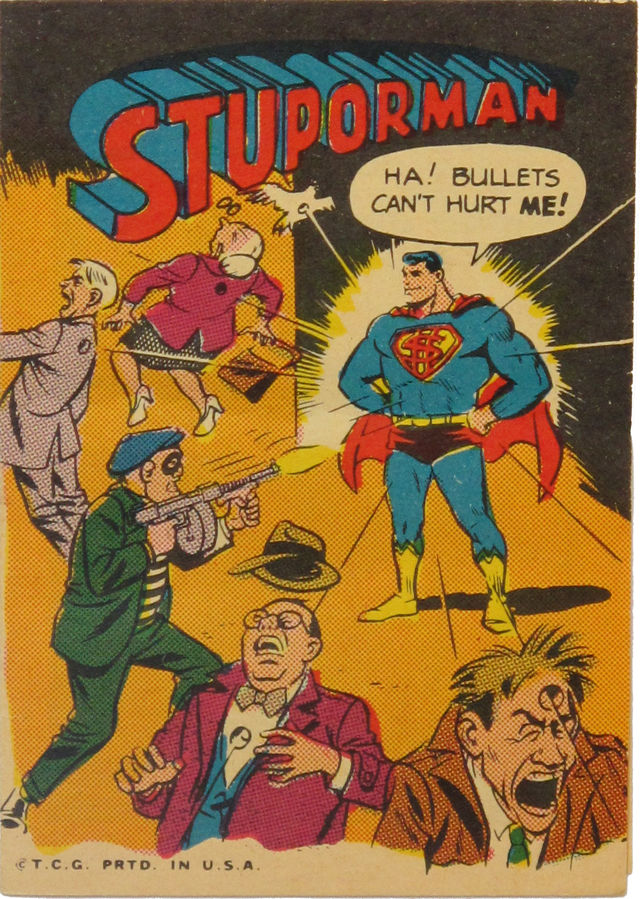
Ha! Bullets Can't Hurt ME

Negative SEO vs Sabotage

Just about any independent SEO worth their weight who publishes a number of websites has at least once hit a snag & been filtered or penalized. A person can say "not me" but how do they operate optimally in both the short term and long term if they never operate near limits or thresholds? But now that Google has begun actively penalizing sites for unnatural link profiles & tightening these thresholds, competitors have been giving one another shoves. Some of the most widely highlighted examples of crappy SEO were not attempts at SEO, but intentional competitive sabotage.

Why Many SEO Thought Leaders Remain Ignorant About SEO

Recently there have been numerous claims that negative SEO doesn't work made by people who should know better.

Many of them don't know any better though, due to a combination of being naive, trusting public relations messaging as being the truth, and a general lack of recent experience on smaller sites.

If someone only...

  • does consulting for large corporate clients
  • works in house at a big company
  • publishes a site about SEO and doesn't build & market sites in competitive areas

... it is easy to bleat on about how negative SEO isn't generally possible except for weak sites. Sites that (allegedly) deserve to be hit & must (obviously) lack quality to be so weak.

The Risk of Labeling "Spam"

As highlighted above, some of the most frequently & widely cited spam examples were not examples of spam, but examples of competitive sabotage. Thus anyone who recommends highlighting "spam" can potentially hose businesses that did nothing wrong.

Why Many SEO Consultants Pretend Success & Cheer Brand

Most sites focused on search typically write a syndication of Google fluff public relations and/or are doing cloaked sales pieces claiming that the death of spammers is great because they and their clients keep becoming more successful. Its all fake it until you make it / fake it until you too are driven out of the ecosystem & pretend things are always getting better even when signs point the other direction. This is done for a variety of reasons:

  • not wanting to lose access to Google
  • signaling you have experience working with big brands
  • wanting to signal that you are a safe play in the marketplace

Nobody ever got fired for choosing IBM.

Marketers Sell Whatever Google Promotes

It is far easier to get paid to do nothing than it is to get paid to fight against the waves of the ocean.

So long as Google keeps feeding macro-parasites trying to kill off smaller & independent players you can expect a lot of consultants to push themselves as being a good fit for the big brands that Google is explicitly designing their algorithms around promoting. However this trend won't last forever. Many of those bigger sites are becoming ad networks & at some point Google will see that competitive threat for what it is. They will then decide "the user" would like a bit more diversity in the results & to see more smaller sites rank.

Most Businesses Must be Small

Much like wealth, business distributions follow power laws & most businesses are small in scale. Sure "build brand" is a nice cure all, but building a strong brand requires scale. Not all businesses have the margins required to build brands. And businesses take time to grow.

Quality vs Scale

Scale & quality are not the same thing. Some businesses are intentionally kept small because their owners feel scale requires compromising on quality. Remember the Olive Garden review that went viral, or what the biggest banks did to the global economy a few years ago?

Most Big Companies Start Off Small

Since going public in 1987, Fastenal has been the fastest growing public company. The company was started by a guy who was sorting bolts and nuts in his basement. Now that they are worth $13 billion they are virtually untouchable, but if 30 years ago online was a big sales channel & someone negative SEOed him his business could have been toast.

Big businesses come from small businesses, as does most innovation. However, if the underlying market is absurdly unstable that retards investment in growth and innovation in companies like Fastenal:

The Fastenal story began in November 1967 when company founder Bob Kierlin opened the very first Fastenal store in his hometown of Winona, MN. The front counter was a salvaged door, about a dozen people attended the "grand opening" weekend, and the first month's sales totaled $157.

One of the biggest failures of modern societies is the self-serving myth of too big to fail.

If SEOs believe that size of a business is the primary legitimate proxy for quality, they should either hire thousands of employees or go get a job at Wal-Mart.

Categories: 

Source: http://feedproxy.google.com/~r/seobook/seobook/~3/EsdnHWulNss/negative-seo

how to whiten teeth at home how to whiten teeth

Friday, 29 June 2012

Kindle fire Christmas

Since the birth with the Kindle Fire Christmas, not only has it turn into a new phase in technology and Kindle Fire development has increased and given people products that merely a long time ago weren?t even possible. Amazon can provide Kindle fire Christmas from $199 to $140 Amazon has advanced into this market using [...]

Source: http://homemadechristmasgift.org/2011/12/kindle-fire-christmas/

how to whiten teeth at home how to whiten teeth

HTC Flyer Coupon Codes 2011

This lens will be about the HTC Flyer Coupon Codes. It will give you information you need to know in order to find the best deal, sales and discounts on the HTC Flyer tablet. Looking for the HTC Flyer Coupon Codes to get the best deals and sales on the well-known HTC Flyer tablet? There [...]

Source: http://homemadechristmasgift.org/2011/11/htc-flyer-coupon-codes-2011/

how to whiten teeth how to whiten teeth at home

Thursday, 28 June 2012

White Kindle Fire For 2012

White Kindle Fire For 2012 – With convenience and protection bound together in one lightweight case, the Dante 360 allows you to enjoy your Kindle Fire anytime, anywhere, at the exact angle most comfortable for your reading and relaxing enjoyment. Its stylish exterior and plush interior provide the professional look you need at work and [...]

Source: http://kindlefirecoupons4u.com/2011/12/white-kindle-fire-for-2012/

how to whiten teeth how to whiten teeth at home

Wednesday, 27 June 2012

Bing Offers Up a Free Link Graph

Bing refreshed their webmaster tools offering & now allows you to look up link data for 3rd party sites.

We recently interviewed Bing's Duane Forrester about the new SEO tools & their product roadmap.

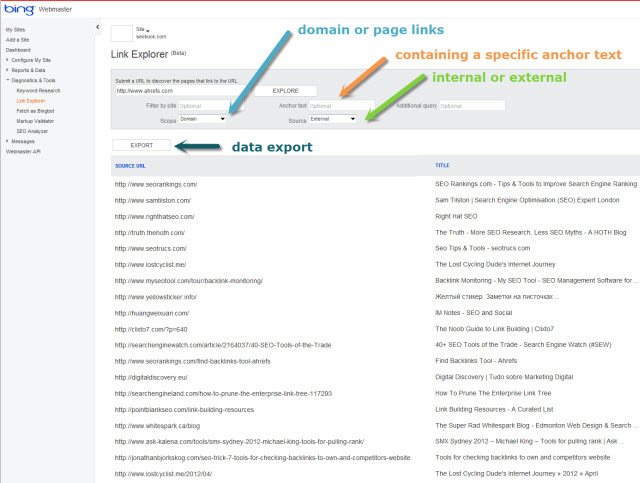
Here is a screenshot of their new link explorer, but I highly recommend setting up an account and checking it out firsthand.

For a long time Yahoo! provided great link data, but most other search engines were more reserved with sharing link data for competing sites. What were some of the driving forces behind Bing opening up on this front?

Bing values the power of strong partnerships as one way to spur innovation and deliver compelling experiences for our users. For any partnership to be effective, remaining as transparent as possible is critical, including those we forge with agency and publisher partners. Sharing link information was something very clearly asked for by tool users, so after doing the internal work to see if we could provide the information, it was an easy decision to build this tool when the answer came back positive. You wanted it, we had it and could share it. Done.

As a search engine your web index is much much larger than most SEO tools. On Twitter Rand mentioned that the index size of Bing's new Link Explorer was fairly comparable to Open Site Explorer. Is the link data offered in the tool a select slice of the index? Were you trying to highlight the highest quality link sources for each site?

We see the entire index, or at least "can" see the entire index and link ecosystem. We?re limited to the actual number we can show at any given time, however.

Currently it appears as though the tool lists link source URLs & page titles. Will the tool also add anchor text listings at some point?

On the list ? sometimes we run into data sourcing issues, so when we hit those walls, it takes us longer to add features. Bing WMT pulls data from all the sources available within Bing Search, and sometimes those have limits imposed for other reasons. In those cases, we must abide by those rules or seek to influence changes to increase our own access/capacities. A search engine is a complex thing it turns out? J

There are filters for "anchor text" and "additional query." What are the differences between these filters?

Anchor Text is pretty clear to most SEOs. "Additional Query" allows you to look for, as an example, a page with "N" text appearing on it. So text not just as "anchor text", but simply appearing on the page.

Currently if I search for "car" I believe it will match pages that have something like "carson" on it. In the future will there be a way to search for an exact word without extra characters?

I?m going to split this answer. Users can enable ?Strict? filtering to only see ?cars? data by selecting the ?Strict? box. To your point, however, this is what some of our tools are Beta. We will continually refine them as time goes on, adding features folks find useful.

Will you guys also offer TLD-based filters at some point?

First time anyone's mentioned it, so I?ll add this to our list for consideration.

A few years ago my wife was at a PPC seminar where a Bing representative stated that the keyword search data provided in the tools matched your internal data. Is this still the case?

Bing Advertising is completely separate from Webmaster Tools. I?m not sure if that rep was meaning data within the adCenter tools matches data or what. Bing WMT does import CPC data to showcase alongside keywords which sent traffic to your site. That data matches as we pull direct from adCenter. The data we show through our tools comes direct from Bing Search, so that?s a match if this is what you?re referring to.

Bing's Webmaster tools offers an API with keyword research & link data. Bing's Ad Intelligence is easily one of my 3 favorite SEO tools. Will Bing eventually offer a similar SEO-oriented plugin for Excel?

No plans on the roadmap for an Excel plugin.

At SMX Derrick Connell suggested that there was a relevancy perception gap perhaps due to branding. What are some of the features people should try or things they should search for that really highlight where Bing is much stronger than competing services?

Without doubt people should be logging in and using the Facebook integration when searching. This feature is tremendously helpful when you?re researching something, for example, as you can reach out directly to friends for input during your research process. While searching, keep your eyes open for the caret that indicates there is more data about a specific result. Hovering over that activates the ?snapshot? showing the richer experience we have for that result. Businesses need to make sure they focus on social and managing it properly. It?s not going away and those who lag will find themselves facing stiff, new competition from those getting social right. Businesses also need to get moving adopting rich snippets on their sites. This data helps us provide the deeper experiences the new consumer interface is capable of in some cases.

You have wrote a couple books & done a significant amount of offline marketing. One big trend that has been highlighted for years and years is everything moving online, but as search advances do you see offline marketing as becoming an important point of differentiation for many online plays?

In a way yes. In fact, with the simplification of SEO via tools like our own and many others, more and more businesses can get things done to a level on their own. SEO will eventually become a common marketing tactic, and when that hits, we?re right back to a more traditional view of marketing: where all tactics are brought to bear to sell a product or service. Think of this?email marketing is still one of the single best converting forms of marketing in existence. Yet so many businesses focus on SEO (drive new traffic!) instead of email (work with current, proven shoppers!).

In fact, neither alone is the "best" strategy for most online businesses. It?s a blend of everything. Social happens either with you or without you. You can influence it, and by participating, the signals the engines see change. We can see those changes and it helps us understand if a searcher might or might not have a good experience with you. That can influence (when combined with a ton of other factors, obviously) how we rank you. Everything is connected today. Complex? Sure, but back in the day marketers faced similar complexity with their own programs. Just a new "complex" for us today. More in the mix to manage.

What is the best part about being an SEO who also works for a search engine?

On Wednesday, June 6th at 10AM PST, I was part of the team that brought a new level of tools forward, resetting expectations around what Webmaster Tools should deliver to users. Easily one of the proudest moments of my life was that release. While I?m an SEO and I work for the engine, the PM and Lead Engineer on the WMT product are also SEOs. ;) To say Bing is investing in building the partnership with SEOs is no mere boast. Great tools like this happen because the people building them live the life of the user.

What is the hardest part about being an SEO who also works for a search engine?

Still so few people around me that speak this language. The main difficulty is in trying to understand the sheer scope of search. Because everything you thought you knew as an SEO take son an entirely different dimension when you?re inside the engine. Imagine taking every SEO conversation and viewing it through a prism. So many more things to consider.

And, finally, nothing against Matt here, but why are dogs so much better than cats?

1 ? they listen to you and execute commands like a soldier
2 ? generally, they don?t crap in your house
3 ? you can have a genuine conversation with a dog
4 ? one of my dogs drives
5 ? when was the last time your cat fetched anything for you?
6 ? your dog might look at you funny, but won?t hiss at you
7 ? guard cat? Hardly? you?d be better off with peacocks in the yard.
8 ? dogs make great alarm clocks
9 ? even YOU know you look strange walking your cat on a leash?
10 ? dogs inspire you to be a better person

-----

Thanks for the interview Duane & the great new tools. :)

Duane also did a video review of their new tools on SEOmoz, which highlights how they show rank & traffic data on a per keyword & per page basis. To learn more about Bing, subscribe to their search blog & their webmaster central blog. Duane also shares SEO information on Twitter @DuaneForrester & via his personal blog.

Categories: 

Source: http://feedproxy.google.com/~r/seobook/seobook/~3/yagAeCtW3bM/bing-offers-free-link-graph

how to whiten teeth at home how to whiten teeth

Editorial Objectivity

Consumer Search Insights.

Should search engines be able to preferentially promote their own services in their search results?

Nearly 3 in 4 people think that search engines should not be able to preferentially promote their own services.

vote All (1226)
no, results should be objective 74.1% (+3.1 / -3.4)
yes, it is their search results 25.9% (+3.4 / -3.1)

There was essentially no split between men & women.

vote Men (827) Women (399)
no, results should be objective 73.7% (+3.1 / -3.4) 74.4% (+5.2 / -6.0)
yes, it is their search results 26.3% (+3.4 / -3.1) 25.6% (+6.0 / -5.2)

Older people tend to prefer/want more editorial objectivity, whereas younger people are more fine with search engines preferentially promoting their own services. Older people tend to be more fixed in their ways & younger people are much less so.

vote 18-24 year-olds (338) 25-34 year-olds (269) 35-44 year-olds (158) 45-54 year-olds (209) 55-64 year-olds (169) 65+ year-olds (83)
no, results should be objective 65.0% (+4.9 / -5.2) 76.0% (+5.1 / -6.0) 74.0% (+6.5 / -7.7) 71.2% (+5.7 / -6.5) 71.4% (+6.5 / -7.5) 87.2% (+6.1 / -10.4)
yes, it is their search results 35.0% (+5.2 / -4.9) 24.0% (+6.0 / -5.1) 26.0% (+7.7 / -6.5) 28.8% (+6.5 / -5.7) 28.6% (+7.5 / -6.5) 12.8% (+10.4 / -6.1)

Geographically, people in the south & midwest tend to be slightly more trusting, perhaps due to the lower cost of living & less competitive markets. However, any differences here are fairly minor & are within the margin of error.

vote The US Midwest (244) The US Northeast (367) The US South (352) The US West (263)
no, results should be objective 72.2% (+6.4 / -7.4) 77.7% (+4.5 / -5.3) 72.1% (+6.0 / -6.9) 75.9% (+5.7 / -6.9)
yes, it is their search results 27.8% (+7.4 / -6.4) 22.3% (+5.3 / -4.5) 27.9% (+6.9 / -6.0) 24.1% (+6.9 / -5.7)

People who are rural tend to be slightly more accepting of Google doing as it wishes, though this is also a small sample size & well within the margin of error.

vote Urban areas (647) Rural areas (106) Suburban areas (453)
no, results should be objective 74.3% (+4.3 / -4.9) 71.9% (+8.5 / -10.5) 74.4% (+4.2 / -4.7)
yes, it is their search results 25.7% (+4.9 / -4.3) 28.1% (+10.5 / -8.5) 25.6% (+4.7 / -4.2)

There isn't a strong correlation with income on this issue either. People cared a bit more at higher income levels, but there was also a wider margin of error due to small sampling size.

vote People earning $0-24K (142) People earning $25-49K (677) People earning $50-74K (316) People earning $75-99K (75) People earning $100-149K People earning $150K+
no, results should be objective 72.0% (+7.8 / -9.4) 76.8% (+3.7 / -4.1) 68.7% (+6.1 / -6.8) 83.1% (+6.9 / -10.2) Insufficient data Insufficient data
yes, it is their search results 28.0% (+9.4 / -7.8) 23.2% (+4.1 / -3.7) 31.3% (+6.8 / -6.1) 16.9% (+10.2 / -6.9) Insufficient data Insufficient data
Categories: 

Source: http://feedproxy.google.com/~r/seobook/seobook/~3/UjyjZbC866I/editorial-objectivity

how to whiten teeth at home how to whiten teeth

Tuesday, 26 June 2012

How to Get Attention Money Can?t Buy

This photo is an illustration of perfect serendipity, and priceless cool. But, you’re not seeing the entire picture … yet. John Hamm (who plays Don Draper) owns an iPhone, and brought it to work. On a break, photographer James Minchin III captured a moment wherein Apple aligns itself with one of the best stories being [...]

Related Stories

Source: http://feeds.feedblitz.com/~/31126799/0/copyblogger~How-to-Get-Attention-Money-Cant-Buy/

how to whiten teeth how to whiten teeth at home

Monday, 25 June 2012

5 Ways to Make Your Marketing Ebooks More Reader-Friendly

books 2intermediate

Our prospects are often inundated with invitations to download online whitepapers, ebooks, and other text-based marketing offers. And while the content that marketers offer may be educational and helpful, their layout often ruins the reading experience and prevents readers from fully understanding the material. 

A better user experience can improve not only the look of your ebooks, but also help readers develop a better understanding of the educational content you're offering. Yet, for some reason, ebook design often comes as an afterthought and doesn’t get fully incorporated into the ebook writing process. Let's change this, shall we? In this post, we'll explore 5 ways in which you can improve the user experience of your marketing ebooks. 

1) Stick to One Message Per Page 

People need constant reassurance that their time is being well spent as they read your content. Remember: there are a million other things they could be doing instead. To put them at ease and enable them to fully focus on your resources, you need to help them understand what each page is about.

Readers don’t have the time to read through each of your paragraphs, only to realize halfway through that a whole section is addressing a subject that didn’t concern them all that much. Allow readers to skim through sections by including headings or subtitles on every page, making it clear what each chunk of content is about. This will enhance the learning process by making the time they spend reading your content much more efficient.


ebook 1


In business blogging, for example, we often use formatting to make the reading experience easier. We add bulleted lists and numbered steps; we separate paragraphs visually with images and headers; and we bold and italicize text we want to emphasize. Take that same approach, and apply it to your long-form writing. Include a title on each page, feature a bolded quotation at the top, or highlight some key piece of data. People often don't have time to read the whole page to determine whether the content is worth reading — format your pages in a way that enables them to quickly and easily choose whether they should read something or move on to another section of your ebook that's more relevant or helpful to them.

2) Use Visuals That Enhance the Reader’s Understanding 

Images and graphics in ebooks are hard to get right. The key to making them fit well is to think of them as an inseparable part of your writing. Whether you add them during or after you’ve finished preparing your ebook’s text-based content, your visuals should highlight an important point you’re making or deconstruct the meaning of a concept in an easy-to-understand way. Images shouldn’t just be there to make the ebook easy on the eyes. Rather, they should be used to enhance the reader’s understanding of the material you’re covering. 

For instance, you might want to deconstruct a piece of data by emphasizing some of the keywords with images. Or you might want to illustrate a process step by step by using a diagram. See the screenshot below as an example — it seeks to demonstrate what an email workflow might look like.


describe the image


3) Maintain Consistency of Style 

In point one, we touched upon the importance of using formatting in ebooks, and that might have led you to think of incorporating a lot of bullet points, colors, fonts, and other styling elements in your writing. It’s easy to start mixing different styles of formatting in an attempt to create some vibrancy. However, it’s important to resist this temptation and stay consistent with your initial style choice.

If you start using a specific line style, title color, or image frame, stick with it. Failing to do so will only create a chaotic experience for your readers and distract them from the knowledge you’re trying to share with them. By being consistent, your readers’ photographic memory will recognize what certain colors and formatting mean from section to section. You can also leverage this concept by bringing those style elements back time and again to reinforce key points.


describe the image


For instance, if throughout your pages you consistently use a rounded blue box with a call-to-action to “learn more” about a specific topic, your readers will learn to anticipate it on the following pages. On the other hand, if you always introduce different shapes and colors, readers won’t make an immediate association of the visual with a message.

4) Embrace White Space 

When I wrote for my college’s newspaper, we often had to fit too many words on too little space. In these cases, we would sometimes increase the margins of the columns and reduce the space between words. One day, an experienced newspaper editor visited us to share some lessons. He saw what we did when we were lacking space in the print edition of our newspaper, and he asked us if we would make the same decision in life — to constantly adjust our standards in order to accommodate one-time needs. He had a great point: that’s not how you achieve high quality. Instead, he advised us to separate or cut the content instead of sacrificing the look and experience of the entire page. Ever since then, I began to cherish white space.

Compare your reaction to a page overflowing with words and one that has just a few, neatly organized columns. The first one is burdensome; the latter inviting. A text-heavy page with no breathing space makes you feel tired even before you start reading. A page that embraces white space and looks clean and simple, on the other hand, welcomes you to explore the content.


describe the image


As you’re reviewing your ebooks, consider how you can separate the content or cut back on it so you don’t ever have to sacrifice the look and feel of your ebook template to increase margins or reduce spacing between words.

5) Avoid Jargon 

Jargon, or also known as gobbledygook, makes everything more difficult to understand. We all want to sound intelligent and authoritative in our writing, but using technical language is not the way to achieve it. Instead of trying to use sophisticated language to convey a point, write simply and clearly. That’s the most effective way of educating readers and helping them understand the new material you’re providing. This is should also hold true for all your other marketing efforts, such as email marketing, call-to-action creation, and landing page production. “Clarity trumps persuasion,” as Dr. Flint McGlaughlin of MECLABS often likes to say.

How else do you ensure a positive user experience of your ebooks and other text-based content? Share your suggestions in the comments below!

Image Credit: jlz

killer-marketing-content

like-what-youaposve-read-click-here


mqlbanner_ima

Source: http://feedproxy.google.com/~r/HubSpot/~3/yMYX74IhYDE/5-Ways-to-Make-Your-Marketing-Ebooks-More-Reader-Friendly.aspx

how to whiten teeth how to whiten teeth at home

General Consumer Awareness of SEM & SEO

Consumer Search Insights.

Which of the following have you heard of?

More people have heard of paid search / AdWords than have SEO / link building. One of the big issues with this question is that since it had numerous check boxes it had a lower response rate (roughly 10% vs an average of closer to 16% to 18%) & took longer for the answers to come in. In the future I can see Google adding quality score styled factors to quizes where pricing is in part based on response rate & they charge premiums for quicker responses. Anyhow, on to the results...

Vote All�(1501)�
Pay Per Click 45.8%�(+2.5 / -2.5)
AdWords 32.7%�(+2.4 / -2.3)
SEO 21.3%�(+2.1 / -2.0)
Link Building 15.9%�(+1.9 / -1.8)
Ad Retargeting 14.9%�(+1.9 / -1.7)

Men tend to have slightly greater awareness of SEO than women. That sort of makes sense given that most SEO conferences are heavily dominated by male attendees.

Vote Men�(755)� Women�(543)� Gender unknown�(203)�
Pay Per Click 45.2%�(+3.6 / -3.5) 45.7%�(+4.2 / -4.1) 48.3%�(+6.8 / -6.8)
AdWords 33.4%�(+3.4 / -3.3) 32.2%�(+4.0 / -3.8) 31.5%�(+6.7 / -6.0)
SEO 24.8%�(+3.2 / -2.9) 18.6%�(+3.5 / -3.0) 15.3%�(+5.6 / -4.3)
Link Building 18.9%�(+2.9 / -2.6) 12.2%�(+3.0 / -2.5) 14.3%�(+5.5 / -4.2)
Ad Retargeting 16.4%�(+2.8 / -2.5) 13.1%�(+3.1 / -2.6) 13.8%�(+5.4 / -4.1)

People in the 25 to 34 age range tend to be more aware of these terms than other age groups.

Vote 18-24 year-olds�(229)� 25-34 year-olds�(316)� 35-44 year-olds�(162)� 45-54 year-olds�(227)� 55-64 year-olds�(182)� 65+ year-olds�(99)�
Pay Per Click 30.1%�(+6.2 / -5.6) 50.3%�(+5.5 / -5.5) 48.8%�(+7.6 / -7.6) 44.9%�(+6.5 / -6.3) 51.1%�(+7.2 / -7.2) 51.5%�(+9.6 / -9.7)
AdWords 37.1%�(+6.4 / -6.0) 40.5%�(+5.5 / -5.3) 32.7%�(+7.6 / -6.8) 33.0%�(+6.4 / -5.8) 22.0%�(+6.6 / -5.4) 20.2%�(+9.0 / -6.7)
SEO 21.4%�(+5.8 / -4.8) 32.6%�(+5.4 / -4.9) 29.6%�(+7.4 / -6.5) 14.1%�(+5.1 / -3.9) 13.2%�(+5.7 / -4.2) 18.2%�(+8.7 / -6.4)
Link Building 17.0%�(+5.4 / -4.3) 17.4%�(+4.6 / -3.8) 16.0%�(+6.4 / -4.9) 15.9%�(+5.3 / -4.2) 15.4%�(+6.0 / -4.5) 12.1%�(+7.9 / -5.0)
Ad Retargeting 12.2%�(+4.9 / -3.6) 16.1%�(+4.5 / -3.6) 17.3%�(+6.6 / -5.0) 18.9%�(+5.6 / -4.6) 11.0%�(+5.4 / -3.8) 16.2%�(+8.5 / -6.0)

The map is sort of all over the map...there are no easily definable regional patterns.

Vote The US Midwest�(320)� The US Northeast�(415)� The US South�(432)� The US West�(316)�
Pay Per Click 43.8%�(+5.5 / -5.3) 47.5%�(+4.8 / -4.8) 43.1%�(+4.7 / -4.6) 48.7%�(+5.5 / -5.5)
AdWords 33.1%�(+5.3 / -4.9) 30.6%�(+4.6 / -4.2) 33.1%�(+4.6 / -4.3) 34.5%�(+5.4 / -5.0)
SEO 18.1%�(+4.6 / -3.8) 24.3%�(+4.4 / -3.9) 19.2%�(+4.0 / -3.4) 22.2%�(+4.9 / -4.2)
Link Building 15.3%�(+4.4 / -3.5) 13.5%�(+3.6 / -3.0) 18.5%�(+3.9 / -3.4) 16.1%�(+4.5 / -3.6)
Ad Retargeting 13.8%�(+4.2 / -3.3) 14.2%�(+3.7 / -3.0) 17.1%�(+3.8 / -3.3) 13.6%�(+4.2 / -3.3)

People in urban areas tend to be more aware of SEM terms than rural people are. This is not particularly surprising since in smaller towns word of mouth and word around the town goes a long way (I used to live in a town of 1200 people) and in cities there is a lot more options than any one person can try & there is far greater noise/competition in the marketplace, both from a consumer and business perspective.

The "unknown" density category only had 32 total responses, so that is just noise.

Vote Urban areas�(793)� Rural areas�(113)� Suburban areas�(563)� Urban Density unknown�(32)�
Pay Per Click 45.4%�(+3.5 / -3.4) 38.9%�(+9.2 / -8.5) 47.8%�(+4.1 / -4.1) 43.8%�(+16.9 / -15.6)
AdWords 35.6%�(+3.4 / -3.3) 27.4%�(+8.9 / -7.4) 29.3%�(+3.9 / -3.6) 40.6%�(+17.1 / -15.1)
SEO 24.7%�(+3.1 / -2.9) 15.9%�(+7.8 / -5.6) 16.9%�(+3.3 / -2.9) 31.2%�(+17.3 / -13.3)
Link Building 15.5%�(+2.7 / -2.4) 17.7%�(+8.1 / -5.9) 16.2%�(+3.3 / -2.8) 12.5%�(+15.6 / -7.5)
Ad Retargeting 14.6%�(+2.6 / -2.3) 19.5%�(+8.3 / -6.2) 13.3%�(+3.1 / -2.6) 31.2%�(+17.3 / -13.3)

There are not many clear patterns among income (that surprises me as I would have thought there was a strong correlation). However, once again, the data is skewed to exclude most people with higher incomes, as there was only 1 response at > $150,000 / year.

Here is the opening chart, followed by the same chart

Vote People earning $0-24K�(178)� People earning $25-49K�(828)� People earning $50-74K�(371)� People earning $75-99K�(88)� People earning $100-149K�(24)� People earning $150K+�(1)� Income unknown�(11)�
Pay Per Click 43.3%�(+7.3 / -7.1) 44.2%�(+3.4 / -3.3) 48.8%�(+5.1 / -5.0) 52.3%�(+10.1 / -10.3) 50.0%�(+18.6 / -18.6) 0.0%�(+79.3 / -0.0) 45.5%�(+26.5 / -24.2)
AdWords 34.3%�(+7.2 / -6.6) 31.9%�(+3.3 / -3.1) 35.0%�(+5.0 / -4.7) 28.4%�(+10.2 / -8.4) 20.8%�(+19.6 / -11.6) 100.0%�(+0.0 / -79.3) 45.5%�(+26.5 / -24.2)
SEO 21.9%�(+6.6 / -5.4) 20.4%�(+2.9 / -2.6) 23.7%�(+4.6 / -4.0) 13.6%�(+8.7 / -5.7) 29.2%�(+20.0 / -14.3) 0.0%�(+79.3 / -0.0) 36.4%�(+28.3 / -21.2)
Link Building 19.1%�(+6.4 / -5.1) 16.3%�(+2.7 / -2.4) 14.6%�(+4.0 / -3.2) 12.5%�(+8.5 / -5.4) 12.5%�(+18.5 / -8.2) 0.0%�(+79.3 / -0.0) 9.1%�(+28.6 / -7.5)
Ad Retargeting 13.5%�(+5.8 / -4.3) 14.1%�(+2.5 / -2.2) 17.0%�(+4.2 / -3.5) 12.5%�(+8.5 / -5.4) 20.8%�(+19.6 / -11.6) 0.0%�(+79.3 / -0.0) 27.3%�(+29.3 / -17.5)

Here is the chart again with those last 2 columns lopped off

Vote People earning $0-24K�(178)� People earning $25-49K�(828)� People earning $50-74K�(371)� People earning $75-99K�(88)� People earning $100-149K�(24)�
Pay Per Click 43.3%�(+7.3 / -7.1) 44.2%�(+3.4 / -3.3) 48.8%�(+5.1 / -5.0) 52.3%�(+10.1 / -10.3) 50.0%�(+18.6 / -18.6)
AdWords 34.3%�(+7.2 / -6.6) 31.9%�(+3.3 / -3.1) 35.0%�(+5.0 / -4.7) 28.4%�(+10.2 / -8.4) 20.8%�(+19.6 / -11.6)
SEO 21.9%�(+6.6 / -5.4) 20.4%�(+2.9 / -2.6) 23.7%�(+4.6 / -4.0) 13.6%�(+8.7 / -5.7) 29.2%�(+20.0 / -14.3)
Link Building 19.1%�(+6.4 / -5.1) 16.3%�(+2.7 / -2.4) 14.6%�(+4.0 / -3.2) 12.5%�(+8.5 / -5.4) 12.5%�(+18.5 / -8.2)
Ad Retargeting 13.5%�(+5.8 / -4.3) 14.1%�(+2.5 / -2.2) 17.0%�(+4.2 / -3.5) 12.5%�(+8.5 / -5.4) 20.8%�(+19.6 / -11.6)
Categories: 

Source: http://feedproxy.google.com/~r/seobook/seobook/~3/v_HSU1Po47g/sem-awareness

how to whiten teeth how to whiten teeth at home

Sunday, 24 June 2012

Ha! Bullets Can't Hurt ME

Negative SEO vs Sabotage

Just about any independent SEO worth their weight who publishes a number of websites has at least once hit a snag & been filtered or penalized. A person can say "not me" but how do they operate optimally in both the short term and long term if they never operate near limits or thresholds? But now that Google has begun actively penalizing sites for unnatural link profiles & tightening these thresholds, competitors have been giving one another shoves. Some of the most widely highlighted examples of crappy SEO were not attempts at SEO, but intentional competitive sabotage.

Why Many SEO Thought Leaders Remain Ignorant About SEO

Recently there have been numerous claims that negative SEO doesn't work made by people who should know better.

Many of them don't know any better though, due to a combination of being naive, trusting public relations messaging as being the truth, and a general lack of recent experience on smaller sites.

If someone only...

  • does consulting for large corporate clients
  • works in house at a big company
  • publishes a site about SEO and doesn't build & market sites in competitive areas

... it is easy to bleat on about how negative SEO isn't generally possible except for weak sites. Sites that (allegedly) deserve to be hit & must (obviously) lack quality to be so weak.

The Risk of Labeling "Spam"

As highlighted above, some of the most frequently & widely cited spam examples were not examples of spam, but examples of competitive sabotage. Thus anyone who recommends highlighting "spam" can potentially hose businesses that did nothing wrong.

Why Many SEO Consultants Pretend Success & Cheer Brand

Most sites focused on search typically write a syndication of Google fluff public relations and/or are doing cloaked sales pieces claiming that the death of spammers is great because they and their clients keep becoming more successful. Its all fake it until you make it / fake it until you too are driven out of the ecosystem & pretend things are always getting better even when signs point the other direction. This is done for a variety of reasons:

  • not wanting to lose access to Google
  • signaling you have experience working with big brands
  • wanting to signal that you are a safe play in the marketplace

Nobody ever got fired for choosing IBM.

Marketers Sell Whatever Google Promotes

It is far easier to get paid to do nothing than it is to get paid to fight against the waves of the ocean.

So long as Google keeps feeding macro-parasites trying to kill off smaller & independent players you can expect a lot of consultants to push themselves as being a good fit for the big brands that Google is explicitly designing their algorithms around promoting. However this trend won't last forever. Many of those bigger sites are becoming ad networks & at some point Google will see that competitive threat for what it is. They will then decide "the user" would like a bit more diversity in the results & to see more smaller sites rank.

Most Businesses Must be Small

Much like wealth, business distributions follow power laws & most businesses are small in scale. Sure "build brand" is a nice cure all, but building a strong brand requires scale. Not all businesses have the margins required to build brands. And businesses take time to grow.

Quality vs Scale

Scale & quality are not the same thing. Some businesses are intentionally kept small because their owners feel scale requires compromising on quality. Remember the Olive Garden review that went viral, or what the biggest banks did to the global economy a few years ago?

Most Big Companies Start Off Small

Since going public in 1987, Fastenal has been the fastest growing public company. The company was started by a guy who was sorting bolts and nuts in his basement. Now that they are worth $13 billion they are virtually untouchable, but if 30 years ago online was a big sales channel & someone negative SEOed him his business could have been toast.

Big businesses come from small businesses, as does most innovation. However, if the underlying market is absurdly unstable that retards investment in growth and innovation in companies like Fastenal:

The Fastenal story began in November 1967 when company founder Bob Kierlin opened the very first Fastenal store in his hometown of Winona, MN. The front counter was a salvaged door, about a dozen people attended the "grand opening" weekend, and the first month's sales totaled $157.

One of the biggest failures of modern societies is the self-serving myth of too big to fail.

If SEOs believe that size of a business is the primary legitimate proxy for quality, they should either hire thousands of employees or go get a job at Wal-Mart.

Categories: 

Source: http://feedproxy.google.com/~r/seobook/seobook/~3/EsdnHWulNss/negative-seo

how to whiten teeth how to whiten teeth at home

Saturday, 23 June 2012

8 Ways to Find Old URLs After a Failed Site Migration - Whiteboard Friday

Posted by iPullRank

In this week's Whiteboard Friday, we are going to be going through some different ways you can track down old URLs after a site migration. These tactics can be incredibly useful for new clients that have just performed a redesign with less than ideal preparation.

I'll be presenting eight ways for you to track down these old URLs, but I would love to see some of your own methods in the comments below. Happy Friday everyone!


Video Transcription

Greetings and salutations SEOmoz fans. My name is Michael King. I'm the Director of Inbound Marketing at iAcquire. I'm also iPullRank on the SEOmoz boards and on Twitter.

So today what we're going to talk about is eight ways to figure out old URLs after a failed site migration. I know you have this problem. You get a new client, they just redesigned, and you have no idea what the old URLs are. They didn't do 301 redirects. They have no idea what the social numbers are anymore, and you have no idea where to start. Well, I'm going to show you how.

Now one of the first tactics you want to use is the Wayback Machine. You just put the site in there, the URL, the domain, what have you, and see what it has in that index. Once you get that, you can easily just pull off those URLs on the site through the links using Scraper for Chrome or whatever tool you want to use. You can actually pull down a code and pull them out using Find and Replace, whatever you want to do. That's just one of the tactics that we're using.

A lot of times people will also not change or update their XML sitemap. So you can just download that XML sitemap and then open it in Excel, and it puts you in these tables. You can just take that first column and copy and paste it into a text file, open it in Screaming Frog, and then crawl and list mode to see if those URLs still exist. Anything that's a 404, that's a URL that you can use, and you can easily map those ultimately to the new URLs on that site.

You also want to use your Backlink profile. When I say that, I don't want you to essentially use one tool, I want you to use as many tools as possible. So definitely start from Open Site Explorer. Also use Majestic, Ahrefs, whatever you want to use, and collect as much link data as possible. Also Webmaster Tools has your links, so use those as well. Then crawl all those links, all the targets of those links and make sure those pages are still in existence. All the 404s, again, you know these are old URLs that you can then redirect to new pages.

Then you also want to check the 404s from Google Webmaster Tools and map those pages to new pages as well. Then you can also use analytics. So pull your historic analytics from before the site redesign and find all those URLs and see which ones are still in existence. Again, go back to Screaming Frog with list mode and make sure that they're 404ing or 200ing. The ones that are 200, you don't have to worry about. The ones that are 404s are the ones that you need to remap.

Then you can also use CMS Change Log. So, for example, when you make a change in WordPress to a URL, there's a record of that, and you can actually pull those URLs out and use those again for mapping.

Then, for those of you that are a little more adventurous, you can go into your log files and see what URLs were driving traffic before it. Same thing as what you would do with the analytics, but just from a server side standpoint rather than just your click path stuff.

And also social media. So people share these URLs. Any shared URL has equity beyond just link equity. So you definitely want to make sure that you're pushing those social shared numbers to the right URLs that you're mapping towards, and I wrote a post on that on Search Engine Watch for how you can do that. But you can use the Facebook recommendations tool. So it's not really a tool. It's a demo for widget that goes on your site. But essentially, you can go through this tool and put in the domain name, and it's going to give you all the shared URLs, all the shared content. The way it comes in the box is it's 300 pixels tall, but if you expand that to a 1,000 pixels, you'll see the top 20 pieces of content that were shared. So real easily identify a popular URL that you can then redirect.

Also you can Topsy the same way. If people have tweeted these URLs, you can just put that domain name in there. It's going to search for them. It's going to give you all the URLs that Topsy has indexed. You can also use Social Mention, any social listening tool you can use the same way. And then also social bookmarks, so things like Digg, Delicious, and such, look and see what people have actually shared and bookmarked for your site.

So that's a quick one. Hope you guys found that useful, and I'd love to know how you guys have found this to be worthwhile. So holler at me in the comments down there, and thanks very much. Peace.

Video transcription by Speechpad.com


Sign up for The Moz Top 10, a semimonthly mailer updating you on the top ten hottest pieces of SEO news, tips, and rad links uncovered by the Moz team. Think of it as your exclusive digest of stuff you don't have time to hunt down but want to read!

Source: http://feedproxy.google.com/~r/seomoz/~3/oQGE6QW1B6o/8-ways-to-find-old-urls-after-a-failed-site-migration-whiteboard-friday

how to whiten teeth at home how to whiten teeth

How to Get Attention Money Can?t Buy

This photo is an illustration of perfect serendipity, and priceless cool. But, you’re not seeing the entire picture … yet. John Hamm (who plays Don Draper) owns an iPhone, and brought it to work. On a break, photographer James Minchin III captured a moment wherein Apple aligns itself with one of the best stories being [...]

Related Stories

Source: http://feeds.feedblitz.com/~/31126799/0/copyblogger~How-to-Get-Attention-Money-Cant-Buy/

how to whiten teeth at home how to whiten teeth

Friday, 22 June 2012

Identifying Link Penalties in 2012

Posted by RyanKent

It was the best of times, it was the worst of times. For SEOs and webmasters in June 2012, that sentiment is true. Some websites have reached record highs in SERPs since the sites which have been beating them for so long have been penalized. Other websites have received what is clearly the most painful, costly and time consuming penalty Google has ever dished out. The current Google penalty for manipulative links is so bad one of the seriously suggested solutions is to abandon the affected site and start a new one!?!?

The first step in dealing with a penalty is identification. Site owners often are not immediately aware they have been penalized. They notice a drop in traffic or rankings, then begin to investigate the issue. So how do you really know if your site has been penalized? Once you know you have been penalized, how can you figure out the cause and fix it?

Diagnosing Link Penalties

Google Manual Penalty with Notification

The easiest means to diagnose the penalty is if Google informs you they have penalized your site for manipulative links. Log into your Webmaster Tools account and search your message page from Google. Below is an image of the dreaded Google "you have been manually penalized" message. According to Matt Cutts, about 25,000 webmasters received similar notices earlier this year.

NOTE: identifying information such as web addresses have been removed from all images to protect client confidentiality.

Google link penalty

The key elements of the above message are:

  1. “We’ve detected that...”. Translation, you have been caught and will be penalized.
  2. “look for possibly artificial or unnatural links...”. Translation, the cause of the penalties is “unnatural” links.
  3. “Submit your site for reconsideration”. Translation, you have a manual penalty.

As bad as this message is, it is better than not knowing and guessing whether you have been penalized and what is the root cause. You now know you have a manual penalty due to unnatural links. Now you can focus your attention on fixing the problem.

If you do not have a manual penalty notice, then another possibility is you have been hit by Penguin.

Google Algorithmic "Penalties" - Penguin

penguinPenguin’s birthday is April 24th, 2012. What day did your rankings drop? If your ranking drop is right around that time, there is a strong likelihood your traffic drop is Penguin related. If you are unsure of the exact date, take a look at your Google Analytics account to see when your traffic dropped.

TIP – In your GA account, go to Traffic Sources > Search > Organic. Do not expect to see a straight off the cliff drop in traffic. Most of the Penguin penalties I have seen involve about a 1/3 drop in organic search traffic. You will notice your overall organic search traffic for the two weeks after April 24th is approximately 1/3 lower than the two weeks before April 24th. If your site was boosted by a larger percentage of manipulative links, the drop can be more severe.

It's important to note that the Penguin changes are NOT about improving search quality, but rather seems to be focused on penalizing specific types of spam. The most particular focus seems to be on anchor text "over-optimization". For more information on the Penguin update please watch Rand's WBF update on Penguin.

Many clients ask "why was my site penalized but my competitor's site was left untouched?" We have all seen plenty of instances of this happening. It's similar to asking a cop "why am I getting pulled over for speeding when all these other cars are speeding too?" A line was drawn in the algorithmic sand and you were found to be on the wrong side of the line. With future updates, the line may move and hit your competitor's site too. That response isn't very comforting but it is the closest we are likely to get to the truth.

Other Google Link Penalties

Google often manually penalizes sites and does not inform site owners of the penalty. Furthermore, Google makes many algorithm changes each year. Most people are aware of the major algorithm changes, but you should also know Google makes about 50 algorithmic changes each month which could lead to ranking changes or an "algorithmic penalty". With the Penguin update specifically, we are unsure if there will be further refinements and rollouts as has happened with Panda. On May 25th Google rolled out what Search Engine Land calls Penguin 1.1

What advice is available for a site owner who wants to know if they have received a link penalty or at risk in the future?

Check your anchor text distribution to see if it appears natural. You can perform a fast check in Open Site Explorer of your top 20 links as follows:

  1. Go to http://www.opensiteexplorer.org/
  2. Enter in the URL of your site and press <enter> or the SEARCH button
  3. Change your drop down box settings as follows: Show [followed + 301] links from [only external] pages to [pages on this root domain]…..then press the FILTER button. These settings will remove the “nofollow” and internal links which are not evaluated by Google as part of link penalties.
  4. You will now see a list of all links to your site which may cause you to incur a penalty. For now, focus only on the Link Anchor Text column. If 50%+ of your top 10 links show the same or very similar anchor text, that is a warning sign of a very unnatural link profile. Of course, a deeper analysis is desirable but this method offers you some idea of the problem in just a few seconds.

Hopefully your anchor text distribution looks more natural than the below example. Notice how all the links show anchor text? A natural distribution would show a high percentage of links with simply the site URL. When anchor text is naturally used, it is often far less than ideal.

manipulative anchor text OSE

So what does a natural profile look like? It is easiest to show from AHREFs (https://ahrefs.com/), a tool similar to OSE but which offers a cool anchor text report.

Below is the anchor text distribution report for GNC.com. GNC stands for General Nutrition Center. They sell vitamins, supplements and other health products. According to AHREFs, GNC.com has 5700+ domains linking to their website. The report below shows the top 10 anchor text keywords used in their backlinks. Notice all the keywords are their unique brand / site name, or generic terms such as click here to view website. What you don’t see is anchor text such as “buy vitamins” or “best herbal products”. Even if their 11th highest anchor text used a keyword, it would only represent 1% of the links to their site. THAT is a natural link profile. You can see similar profiles by looking at sites such as seomoz.org and google.com as well, but I wanted to use an e-commerce site to show how those sites can achieve the same results.

AHREFs anchor text distribution GNC.com

In comparison, below is the backlink profile for the site first shown with the OSE anchor text distribution. This site has 335 linking root domains as per AHREFs. Notice the difference? 70 of the site’s 335 LRDs (over 20%) use the exact same keyword anchor text. This particular domain name, which uses the format doctorjohnsmith.com, has no relation to “los angeles dentist”. What are the chances that 20% of domains naturally chose that anchor text?

If your site’s anchor text distribution looks similar to the below, expect to be hit by a penalty. As a note, it appears this particular site has NOT been hit by Penguin, but I would suggest it is a prime candidate for Penguin 2.0 if Google decides to move in that direction.

AHREFs anchor text chart

Final Thoughts

There are some reports from site owners who were penalized by Google after 301 redirecting a penalized site to their site. There is not enough data on this topic to form any conclusions yet.

I can confirm two other items related to these penalties. First, any form of link network is a concern. The first client I worked with who had been penalized for links was in November of 2011. The client is a leader in their niche selling $18 million worth of products the prior year. Over a 12 year period the client grew a network of over 100 sites, mostly various forms of duplicate content of the main site. These were very large sites having hundreds of thousands of pages. By dismantling the network, we removed over 3.5 million links. If you are penalized, you should consider other sites you own which link to your main site. Ross Hudgens credits the removal of links from other company owned sites as the most critical reason WPMU made a fast Penguin recovery.

The second item I wanted to share relates to Bing. Shortly after the above mentioned client was penalized by Google, they were penalized by Bing as well. Once the Google penalty was lifted, removing the Bing penalty was easy. I simply shared with Bing all the actions taken to resolve the Google penalty and they accepted that answer and lifted the penalty. With all the attention currently on Google, let's not forget that Bing (Bing + Yahoo) controls approximately 30% of search traffic in many markets.

Thanks for reading. I hope you find this information helpful.

This is my first SEOmoz blog article. I spend most of my limited free time in the Q&A. There seems to be a huge interest in both diagnosing and resolving link-related penalties. If this article is popular, I will write a follow-up article soon on How to Remove Link Penalties sharing some case-study examples. If you have any questions related to diagnosing link penalties, feel free to ask. I would like to extend a special thanks to Gianluca Fiorelli and Keri Morgret for nudging me to become more active in YouMoz. This article would not have been written without their encouragement.


Sign up for The Moz Top 10, a semimonthly mailer updating you on the top ten hottest pieces of SEO news, tips, and rad links uncovered by the Moz team. Think of it as your exclusive digest of stuff you don't have time to hunt down but want to read!

Source: http://feedproxy.google.com/~r/seomoz/~3/ovkp8DRHpVc/identifying-link-penalties-in-2012

how to whiten teeth how to whiten teeth at home
Thursday, 21 June 2012

GoogleBowling, Negative SEO & Outing

Excessive Complexity & Unintended Consequences

Sergey Brin recently said:

You have to play by their rules, which are really restrictive. The kind of environment that we developed Google in, the reason that we were able to develop a search engine, is the web was so open. Once you get too many rules, that will stifle innovation.

He was talking about Facebook, but those words are far more applicable to Google.

A Social Experiment

In the movie Dark Knight the Joker ran a social experiment where he offered 2 boats full of people the opportunity to save their own lives by blowing up the other boat. The boat full of "criminals" threw the button overboard & the other boat also decided not to push the button.

Of course taking someone's life is more extreme than taking their livelihood, but if you do the latter it might create stress and/or other issues which in effect lead to the former. Some people who see their income disappear might have a heart attack, others might have marriages that soon falls apart, leading into a spiral of depression and substance abuse & eventually suicide. Others still might have employees that get laid off & end up heading down some of the same scary paths - through no fault of their own.

Negative SEO Goes Mainstream

Anyone who outs or link bombs smaller businesses (small enough that Google punishing them destroys their livelihood rather than just giving them a bad quarter) is a _______. Anyone who advocates outing or link bombing such businesses is an even larger _______.

Why?

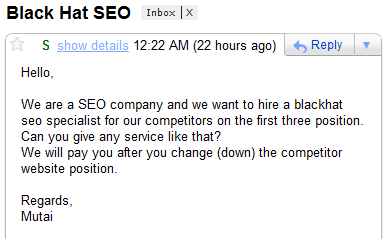
With all of Google's warning messages about abnormal links they have built the negative SEO industry in a big way. In some instances those who are not good enough to compete try to harm competitors. I received emails & support tickets like the following one for years and years...

...but the rate of demand increase for such "services" has been sharp this year. Every additional warning message from Google creates additional incremental demand.

And this is where outing a competitor makes one a total and complete _______ of a human being.

A Recent (& Very Public) Example of Negative SEO

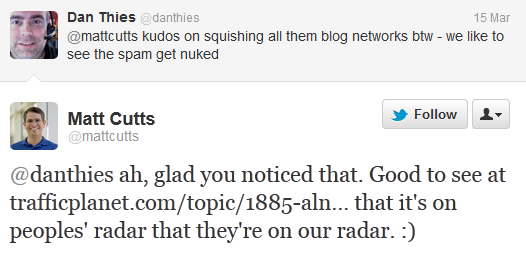
Dan Thies mentioned that it was "about time" that Google started hitting some of the splog link networks.

Anyone who knows the tiniest bit about the social sciences could predict what came next.

In response to his Tweet, someone signed his site up for some splog links & Scrapebox action. Now he is getting warnings about his unnatural link profile. Dan didn't intentionally violate Google's guidelines, but he became a convenient target:

15th March - Dan Thies posts smug tweets to Matt Cutts and pisses off the entire internet.
18th March - seofaststart.com - blog posts started - anchor text "seo" "seo service" and "seo book"
22th March - seofaststart.com - 1 million scrapebox blast started - 100% anchor text "Dan Thies"
26th March - Dan Thies posts in Twitter that he has received an unnatural links message.

Since then Dan has installed a new template & his rankings tanked. Is it the template or the spam links? Probably the spam links, given how many other sites have got hit for using too much focused anchor text.

  • Will the site stay tanked? If so, now Google's approach to anchor text & link spikes allows independent websites to get torched in a few weeks for a few Dollars.
  • Or will the site come back stronger than ever with the help of the spam links? If it does, then how long is it before people start accidentally spam blasting their own websites & posting a public case study about burning a competitor on a forum, then citing that forum thread in their reconsideration request?
  • If the site quickly comes back, will that be due to a manual intervention by a search engineer, or from an algorithm more advanced than some people are giving it credit for being?

When asking such questions one quickly arrives at another set of questions. Is it the web that is broken? Or is it Google's editorial approach that is broken? If the observer breaks the system they observe, then the observer is the problem.

The Bigger Issue

The bigger issue isn't the short term trends for SEO related keywords or Dan's site (he will be fine & rankings are not that important for sites about SEO), but the big issue is that if this can happen to a decade old website then this can happen to literally anybody.

Piss off a ...

  • competitor
  • SEO
  • web designer
  • web developer
  • business partner
  • blogger
  • blog reader
  • former customer
  • freetard
  • ex-friend
  • bitter family member
  • insert any classification or category you like
  • etc.

... and risk getting torched.

When you out someone for shady links, you can't be certain they were responsible for it. They could have had a falling out with a consultant or business partner or another competitor who wanted to hose them. Or their SEO or webmaster could have been non-transparent with them.

Then you out them & they might be toast.

White Hat, Black Hat & ________ Hat SEO

Any of the ________ who promote competitor smoking or competitor outing as somehow being "ethical" or "white hat" never bother to explain what happens to YOU when someone else does that to you.

Sketchy marketers can make just about anything look good at first glance. No matter how shiny the package in concept, it is hard to appreciate the pain until you are the one undergoing it.

Building things up is typically far more profitable than tearing things down & if SEOs go after each other then the only winner is Google. Literally every other participant in the ecosystem has higher risk, higher costs & is taxed by the additional uncertainty. Sure some of the conscripts might get a bit of revenues and some of the "white hat" hacks might gain incremental short term exposure, but as the marrow is scraped out of the bone, they too will fall hard.

Google is betting that the SEO industry is full of ________. If our trade is to worth being in, I hope Google is wrong! If not, you will soon see most of the quality professionals in our trade go underground, while only the hacks who misinform people & are an unofficial extension of Google's public relations team remain publicly visible.

That might be Google's goal.

Will they be successful at it?

That depends entirely on how intelligent members of the SEO industry are.

Categories: 

Source: http://feedproxy.google.com/~r/seobook/seobook/~3/wNJb46tl48c/negative-seo-outing

how to whiten teeth how to whiten teeth at home