Twoo là nơi vui vẻ để gặp bạn mới sống gần nơi bạn ở
Tham gia cùng 10 triệu người.
Twoo là mạng xã hội kết bạn trát triển nhanh nhất. Hãy tìm hiểu vì sao 10 triệu người đã tham gia Twoo!
Chat ngay
Khi bạn gặp một thành viên thú vị bạn sẽ muốn bắt chuyện? Trên Twoo, chúng tôi bảo đảm có rất nhiều người muốn chat. Và tuyệt hơn cả: việc này miễn phí!
Di động
Luôn luôn cập nhật với ứng dụng iPhone và Android. Mang Twoo đến mọi nơi.
Không muốn nhận những email này nữa? Nhấn ở đây. Massive Media NV, Emile Braunplein 18, 9000 Ghent, Belgium info-vi@twoo.com BE0834322338.
As Nexus 7 is competitor of Kindle Fire, the situation has complicated the atria player. The Mountain View company has in fact had the industrial capacity to produce a cheap tablet but at the same time with excellent technical features, thanks to Nvidia Kai, an optimized version of the SoC Tegra 3 that made it possible to reduce cost while maintaining virtually unchanged performance and introducing a wide range of services.
Google Nexus 7 coupon code save 40%:
NEXUS40
Traditional companies do not have this possibility and could have serious difficulty now to propose tablet competitive price and included in this market segment which then is where we make the most income. Some online sites have proposed a brief comparison between Google Nexus 7 VS Samsung Galaxy Tab 2 7.0 where our assumption is easily demonstrated. The device has a display such as Korean PLS (the proprietary version of IPS technology) from 7-inch diagonal like the Nexus 7 (which is precisely the type IPS ), but the resolution of the first stops at 1024 x 600 pixels, while the second arrives at 1280 x 800 pixels , with a density of pixels per inch considerably higher.
Same situation for the hardware platform: the Galaxy Tab 2 it is equipped with a SoC Texas Instruments OMAP 4430 processor with dual core ARM Cortex A9 1 GHz, 1 GB of RAM and storage space to local 8, 16 or 32 GB , expandable via SD card, while the Nexus 7 has an Nvidia Tegra SoC 3, supported by 1 GB of RAM and storage from 8 or 16 MB, not expandable.
Subject to the limitations on the storage capacity of the tablet Google is far superior, especially if one also takes into account the operating system, Google Android 4.0 Ice Cream Sandwich for Samsung and instead the new version 4.1 Jelly Bean for the Nexus 7.
Twoo là nơi vui vẻ để gặp bạn mới sống gần nơi bạn ở
Join over 10 million people!
Twoo is the fastest growing network for meeting new people. Find out why over 10 million people have already joined Twoo!
Chat ngay
Khi bạn gặp một thành viên thú vị bạn sẽ muốn bắt chuyện? Trên Twoo, chúng tôi bảo đảm có rất nhiều người muốn chat. Và tuyệt hơn cả: việc này miễn phí!
Di động
Luôn luôn cập nhật với ứng dụng iPhone và Android . Mang Twoo đến mọi nơi.
Không muốn nhận những email này nữa? Nhấn ở đây. Massive Media NV, Emile Braunplein 18, 9000 Ghent, Belgium info-vi@twoo.com BE0834322338.
Looking for the Kindle fire coupon codes to get the best deals and sales on the well-known Kindle fire tabletr? There are many reasons why the Amazon�Kindle fire has become increasingly popular these days. You might be taking into consideration the distinction between the Kindle and the Nook Color if you’re among those looking for [...]
When you search, how did you pick your primary search engine?
Most people use the search engine which they believe has the best relevancy, whatever their computer came with, or what a friend recommended.
Vote
All�(1190)�
it has superior relevancy
30.4%�(+3.0 / -2.9)
the computer had a default selected
26.8%�(+2.9 / -2.7)
a friend told me about it
23.1%�(+2.9 / -2.7)
I saw it on a TV ad
10.3%�(+2.3 / -1.9)
it came bundled with software
9.5%�(+2.3 / -1.9)
Men are more inclined to believe in superior relevancy, whereas women are more likely to use the default or what a friend recommends
Vote
Men�(621)�
Women�(569)�
it has superior relevancy
35.4%�(+4.2 / -3.9)
25.5%�(+4.4 / -4.0)
the computer had a default selected
21.8%�(+3.7 / -3.3)
31.5%�(+4.6 / -4.3)
a friend told me about it
21.3%�(+3.7 / -3.3)
24.8%�(+4.5 / -4.0)
I saw it on a TV ad
11.9%�(+3.1 / -2.5)
8.8%�(+3.5 / -2.6)
it came bundled with software
9.7%�(+2.9 / -2.3)
9.3%�(+3.8 / -2.8)
The youngest age group is easiest to influence with advertising or buying the default placement. 25 to 34 is more concerned about relevancy & older people are more likely to have it bundled with software than younger people are.
Vote
18-24 year-olds�(289)�
25-34 year-olds�(309)�
35-44 year-olds�(151)�
45-54 year-olds�(186)�
55-64 year-olds�(167)�
65+ year-olds�(88)�
it has superior relevancy
30.1%�(+5.5 / -5.0)
36.9%�(+5.9 / -5.5)
32.4%�(+7.8 / -6.9)
28.2%�(+7.0 / -6.1)
27.6%�(+7.7 / -6.6)
28.0%�(+10.8 / -8.7)
the computer had a default selected
29.0%�(+5.5 / -4.9)
23.8%�(+5.4 / -4.7)
27.6%�(+7.6 / -6.5)
24.2%�(+6.8 / -5.7)
26.0%�(+7.6 / -6.4)
26.1%�(+11.3 / -8.8)
a friend told me about it
20.7%�(+5.0 / -4.3)
21.1%�(+5.5 / -4.6)
23.8%�(+7.7 / -6.3)
24.8%�(+7.0 / -5.9)
25.0%�(+7.4 / -6.2)
24.6%�(+11.4 / -8.7)
I saw it on a TV ad
14.2%�(+4.5 / -3.6)
10.8%�(+4.2 / -3.1)
10.5%�(+6.0 / -4.0)
12.8%�(+5.7 / -4.1)
8.3%�(+5.5 / -3.4)
3.1%�(+10.7 / -2.5)
it came bundled with software
6.0%�(+3.4 / -2.2)
7.5%�(+3.9 / -2.6)
5.8%�(+5.4 / -2.9)
10.0%�(+5.3 / -3.6)
13.1%�(+5.8 / -4.2)
18.2%�(+10.6 / -7.3)
People out west tend to be more concerned with / driven by perceived relevancy. People in the midwest rely more on word of mouth. People in the south and north east are more likely to use the default.
Vote
The US Midwest�(236)�
The US Northeast�(317)�
The US South�(369)�
The US West�(268)�
it has superior relevancy
24.4%�(+6.8 / -5.7)
29.8%�(+5.9 / -5.3)
29.6%�(+5.3 / -4.8)
37.2%�(+6.6 / -6.2)
the computer had a default selected
27.3%�(+6.7 / -5.8)
29.3%�(+6.0 / -5.3)
29.8%�(+5.5 / -5.0)
19.8%�(+5.6 / -4.7)
a friend told me about it
25.6%�(+6.9 / -5.9)
18.4%�(+5.4 / -4.4)
22.6%�(+5.3 / -4.5)
25.0%�(+6.1 / -5.3)
I saw it on a TV ad
11.5%�(+5.8 / -4.0)
12.6%�(+4.6 / -3.5)
9.8%�(+4.4 / -3.1)
8.2%�(+4.6 / -3.0)
it came bundled with software
11.2%�(+6.1 / -4.1)
9.9%�(+4.5 / -3.2)
8.1%�(+4.3 / -2.9)
9.7%�(+5.1 / -3.5)
Here is data by population density.
Vote
Urban areas�(612)�
Rural areas�(107)�
Suburban areas�(445)�
it has superior relevancy
29.9%�(+4.2 / -3.9)
27.8%�(+9.9 / -8.1)
30.4%�(+5.3 / -4.8)
the computer had a default selected
27.2%�(+4.4 / -4.0)
27.7%�(+9.5 / -7.9)
26.5%�(+5.1 / -4.5)
a friend told me about it
23.1%�(+4.3 / -3.8)
25.1%�(+9.6 / -7.6)
23.2%�(+4.8 / -4.2)
I saw it on a TV ad
10.4%�(+3.8 / -2.9)
8.7%�(+8.6 / -4.5)
10.5%�(+4.6 / -3.3)
it came bundled with software
9.4%�(+4.0 / -2.9)
10.6%�(+8.8 / -5.1)
9.3%�(+4.5 / -3.1)
There doesn't appear to be any obvious correlations with age.
This week on The Lede … How to Tell Your Story Like a Luxury Brand Louis CK Goes Straight to His Audience (Again) 10 Steps to Building an Amazing Infographic The Power of Consistency The Best Local SEO Strategy You’re Not Using 8 Steps To Knocking Out An Impossible To Do List How to Build [...]
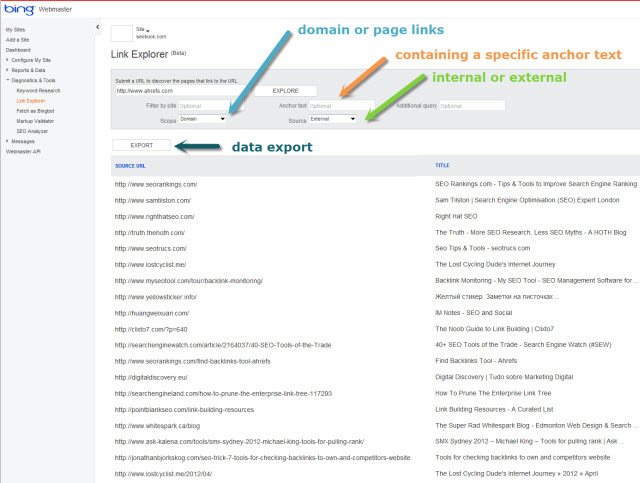
For a long time Yahoo! provided great link data, but most other search engines were more reserved with sharing link data for competing sites. What were some of the driving forces behind Bing opening up on this front?
Bing values the power of strong partnerships as one way to spur innovation and deliver compelling experiences for our users. For any partnership to be effective, remaining as transparent as possible is critical, including those we forge with agency and publisher partners. Sharing link information was something very clearly asked for by tool users, so after doing the internal work to see if we could provide the information, it was an easy decision to build this tool when the answer came back positive. You wanted it, we had it and could share it. Done.
As a search engine your web index is much much larger than most SEO tools. On Twitter Rand mentioned that the index size of Bing's new Link Explorer was fairly comparable to Open Site Explorer. Is the link data offered in the tool a select slice of the index? Were you trying to highlight the highest quality link sources for each site?
We see the entire index, or at least "can" see the entire index and link ecosystem. We?re limited to the actual number we can show at any given time, however.
Currently it appears as though the tool lists link source URLs & page titles. Will the tool also add anchor text listings at some point?
On the list ? sometimes we run into data sourcing issues, so when we hit those walls, it takes us longer to add features. Bing WMT pulls data from all the sources available within Bing Search, and sometimes those have limits imposed for other reasons. In those cases, we must abide by those rules or seek to influence changes to increase our own access/capacities. A search engine is a complex thing it turns out? J
There are filters for "anchor text" and "additional query." What are the differences between these filters?
Anchor Text is pretty clear to most SEOs. "Additional Query" allows you to look for, as an example, a page with "N" text appearing on it. So text not just as "anchor text", but simply appearing on the page.
Currently if I search for "car" I believe it will match pages that have something like "carson" on it. In the future will there be a way to search for an exact word without extra characters?
I?m going to split this answer. Users can enable ?Strict? filtering to only see ?cars? data by selecting the ?Strict? box. To your point, however, this is what some of our tools are Beta. We will continually refine them as time goes on, adding features folks find useful.
Will you guys also offer TLD-based filters at some point?
First time anyone's mentioned it, so I?ll add this to our list for consideration.
A few years ago my wife was at a PPC seminar where a Bing representative stated that the keyword search data provided in the tools matched your internal data. Is this still the case?
Bing Advertising is completely separate from Webmaster Tools. I?m not sure if that rep was meaning data within the adCenter tools matches data or what. Bing WMT does import CPC data to showcase alongside keywords which sent traffic to your site. That data matches as we pull direct from adCenter. The data we show through our tools comes direct from Bing Search, so that?s a match if this is what you?re referring to.
Bing's Webmaster tools offers an API with keyword research & link data. Bing's Ad Intelligence is easily one of my 3 favorite SEO tools. Will Bing eventually offer a similar SEO-oriented plugin for Excel?
No plans on the roadmap for an Excel plugin.
At SMX Derrick Connell suggested that there was a relevancy perception gap perhaps due to branding. What are some of the features people should try or things they should search for that really highlight where Bing is much stronger than competing services?
Without doubt people should be logging in and using the Facebook integration when searching. This feature is tremendously helpful when you?re researching something, for example, as you can reach out directly to friends for input during your research process. While searching, keep your eyes open for the caret that indicates there is more data about a specific result. Hovering over that activates the ?snapshot? showing the richer experience we have for that result. Businesses need to make sure they focus on social and managing it properly. It?s not going away and those who lag will find themselves facing stiff, new competition from those getting social right. Businesses also need to get moving adopting rich snippets on their sites. This data helps us provide the deeper experiences the new consumer interface is capable of in some cases.
You have wrote a couple books & done a significant amount of offline marketing. One big trend that has been highlighted for years and years is everything moving online, but as search advances do you see offline marketing as becoming an important point of differentiation for many online plays?
In a way yes. In fact, with the simplification of SEO via tools like our own and many others, more and more businesses can get things done to a level on their own. SEO will eventually become a common marketing tactic, and when that hits, we?re right back to a more traditional view of marketing: where all tactics are brought to bear to sell a product or service. Think of this?email marketing is still one of the single best converting forms of marketing in existence. Yet so many businesses focus on SEO (drive new traffic!) instead of email (work with current, proven shoppers!).
In fact, neither alone is the "best" strategy for most online businesses. It?s a blend of everything. Social happens either with you or without you. You can influence it, and by participating, the signals the engines see change. We can see those changes and it helps us understand if a searcher might or might not have a good experience with you. That can influence (when combined with a ton of other factors, obviously) how we rank you. Everything is connected today. Complex? Sure, but back in the day marketers faced similar complexity with their own programs. Just a new "complex" for us today. More in the mix to manage.
What is the best part about being an SEO who also works for a search engine?
On Wednesday, June 6th at 10AM PST, I was part of the team that brought a new level of tools forward, resetting expectations around what Webmaster Tools should deliver to users. Easily one of the proudest moments of my life was that release. While I?m an SEO and I work for the engine, the PM and Lead Engineer on the WMT product are also SEOs. ;) To say Bing is investing in building the partnership with SEOs is no mere boast. Great tools like this happen because the people building them live the life of the user.
What is the hardest part about being an SEO who also works for a search engine?
Still so few people around me that speak this language. The main difficulty is in trying to understand the sheer scope of search. Because everything you thought you knew as an SEO take son an entirely different dimension when you?re inside the engine. Imagine taking every SEO conversation and viewing it through a prism. So many more things to consider.
And, finally, nothing against Matt here, but why are dogs so much better than cats?
1 ? they listen to you and execute commands like a soldier 2 ? generally, they don?t crap in your house 3 ? you can have a genuine conversation with a dog 4 ? one of my dogs drives 5 ? when was the last time your cat fetched anything for you? 6 ? your dog might look at you funny, but won?t hiss at you 7 ? guard cat? Hardly? you?d be better off with peacocks in the yard. 8 ? dogs make great alarm clocks 9 ? even YOU know you look strange walking your cat on a leash? 10 ? dogs inspire you to be a better person
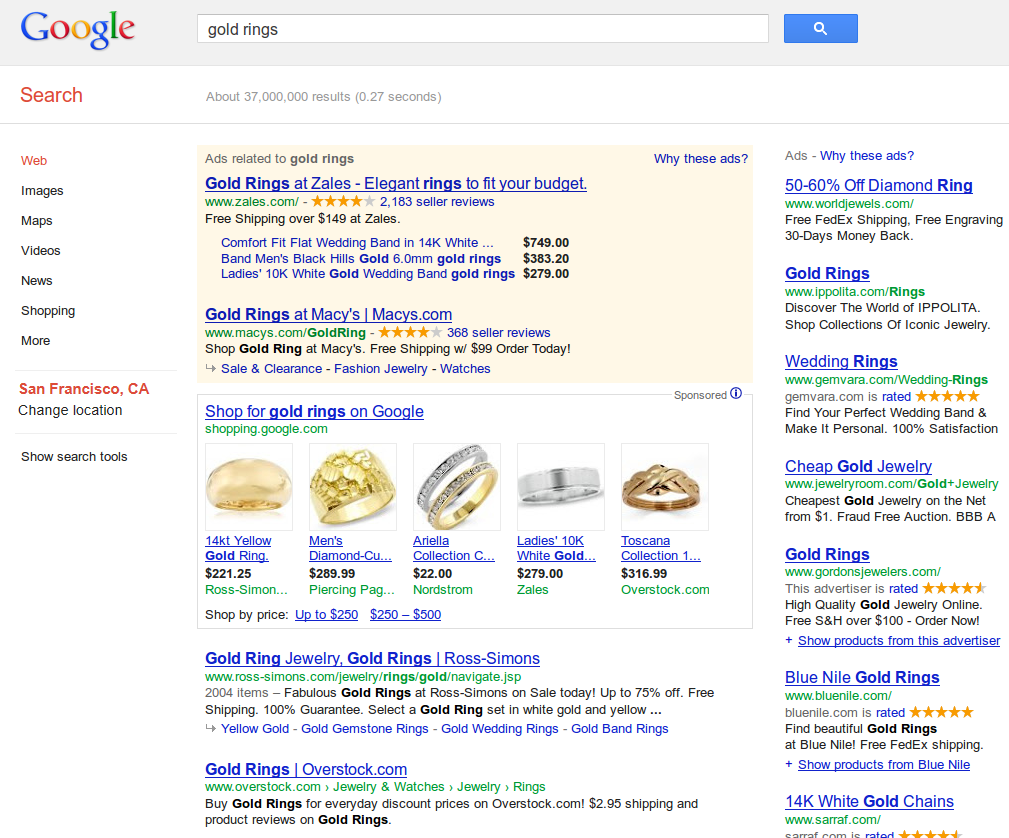
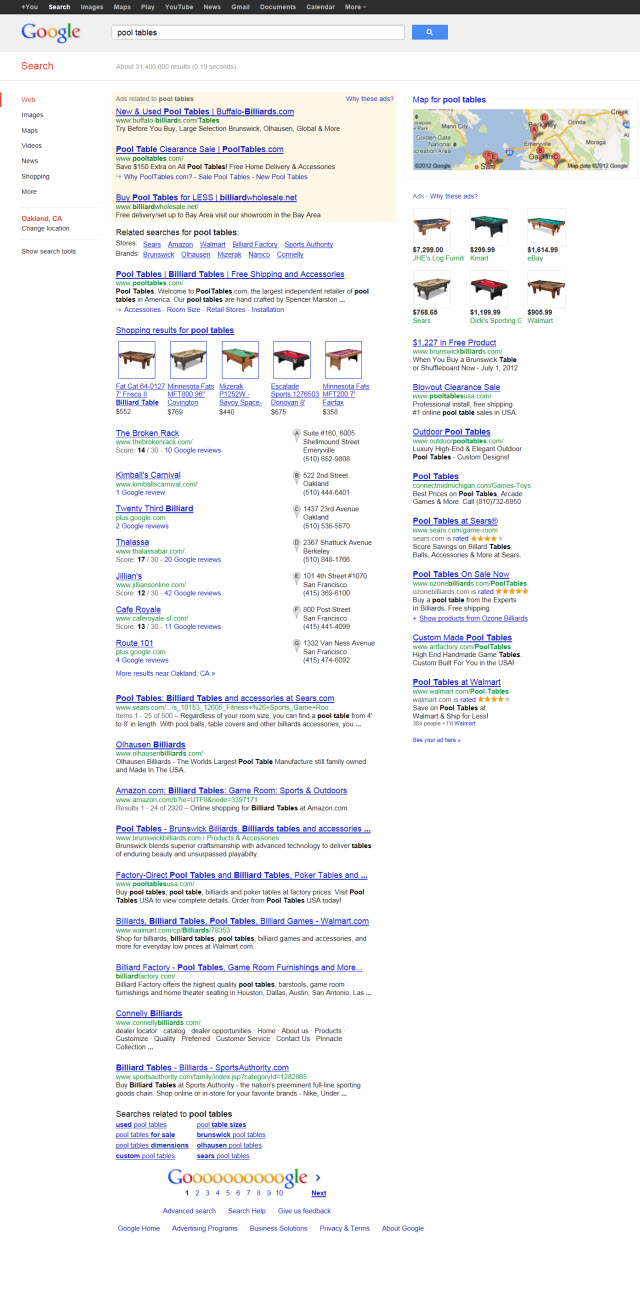
The layout of the result looks something like this
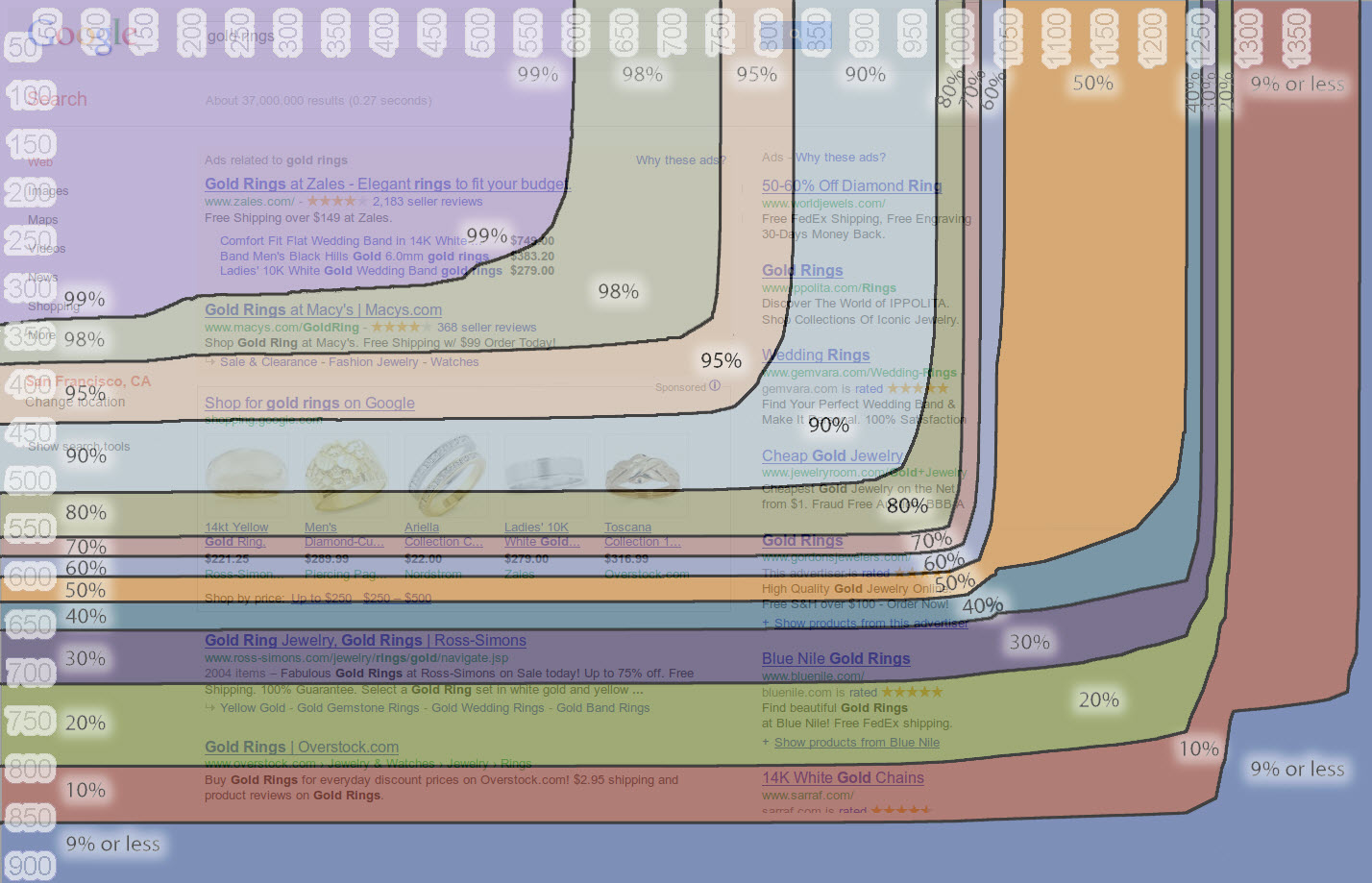
Or if you put it in Google's browser analysis tool, it looks something like this
And with that move, if you are in ecommerce & you don't rank #1 you are essentially invisible to most searchers.
As John Andrews highlighted on Twitter: "Notice Google tells us "paid relationships improve quality" and then penalizes for paid links?"
As always, it is more profitable to follow Google's biz dev team than Google's public relations pablum.
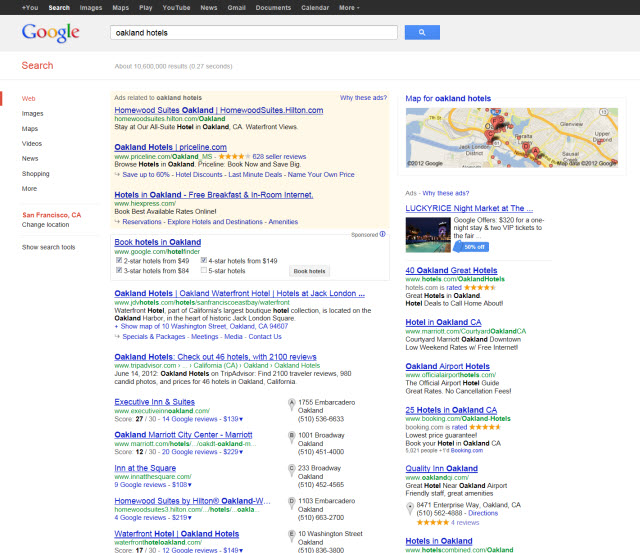
In some cases Google might include 3 or 4 different types of monetization in a search result. In the below search result Google includes:
AdWords ads
Google Offers
Hotel Comparison ads
Hotel Price ads
And those are *in addition* to featuring promotional links to Google Maps & Google+ in the search results. Further, some of these vertical results consist exclusively of paid inclusion & then have yet another layer of PPC ads over the top.
As SEOs we focus a lot of energy on "how do I rank 1 spot higher" but when the organic results are displaced and appear below the fold why bother? The issue of the incredibly shrinking organic result set is something that can't be over-emphasized. For many SEOs the trend will absolutely be career ending.
AdWords, product listing ads, brand navigation, product search, local, etc. A result like this has a single organic listing above the fold & if Google decides to rank their local one spot higher then that turns to zero.
If you look at the new TLD announcement Google applied for .MBA & .PhD (as well as many names around entertainment, family & software). Thus it is safe to say that education will eventually be added to local, video, media, shopping & travel as verticals where Google is displacing the organic results with links to more of their fraternal listings. About the only big categories this will leave unscathed will be real estate, employment & healthcare. However those first 2 are still in contraction during our ongoing depression & Google blew a lot of their health credibility by pushing those illegal ads for steroids from a person posing as a Mexican drug lord.
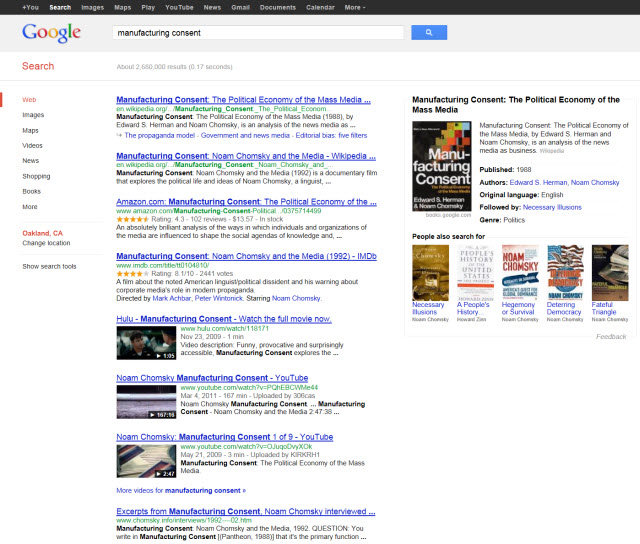
In addition to these fixed vertical that cover the most profitable areas of search, Google is also building a "vertical search on the fly" styled service with their knowledge graph. Their knowledge graph extracts data from 3rd party websites & then can be used to funnel traffic and revenue to Google's various vertical services. To make it seem legit, Google will often start by sending some of the traffic onto 3rd party sites, but the end destination is no different than product search. While it is a "beta" product it is free to justify an inferior product being showcased front & center, but after Google gets enough buy in they monetize.
There is a non-subtle difference between Google's approach and Microsoft's approach to building a search ecosystem.
Let's compare that behavior against Yahoo! or Bing.
Yahoo! has long been considered out of the search game, yet when they want to have a competitive advantage they do things like license photos from Getty. They use the content with permission on agreed terms.
Google's approach is more along the lines of "scrape it now & figure out legal later." And after a long enough period has passed they will add monetization & mix it into the core of their offering, like they recently did with books:
This launch transitions the billions of pages of scanned books to a unified serving and scoring infrastructure with web search. This is an efficiency, comprehensiveness and quality change that provides significant savings in CPU usage while improving the quality of search results.
Eric Enge interviewed Stefan Weitz about the new Bing interface. As part of that interview, Stefan described Bing's editorial philosophy on building a search ecosystem
We partner with 3rd party services instead of trying to build or acquire them. There are probably something like a million apps out there today.
I talk to probably two dozen start-ups every week that are doing different cool things on the web. To think that we are ever going to be able to actually beat them, or out-execute them (when they are talking about 12 guys with half a million angel funding building some really interesting apps), it is just not likely.
Off the start forays into new categories might provide some value to publishers in order to get buy in, but eventually the "first hit free" stuff shifts to paid & Google continues to displace publishers across more and more of the ecosystem, using content scraped from said publishers.
Funding Scraping
When Google or Apple drive cars around the country or fly military-grade planes over cities to create 3D maps of cities they are creating databases & adding new information. Outside of collecting private data (like wifi payload data) there is little to complain about with that. They are adding value to the system.
However, at the same time, Google not only scrapes themselves, but they are a revenue engine that drives a lot of third party scraping. And they design penalties in a way that allows those who scrape penalized sites to outrank them. With batch penalty updates some folks can chain redirects, expired domains & so on to keep exploiting the combination of copyright violations & Google penalties to make a mint. Google also had a long history of funding Traffic Equalizer sites, sites like Mahalo that would take a copy of a search result & auto-generate a page on it, newspaper sites that would hang auto-generated stub preview articles on subdomains, & sites like eHow which integrate humans into the process.
While many sites are still penalized from the first version of Panda, downstream referrals to eHow.com from Google in the US were up over 9% last month. They know "how to create SEO content."
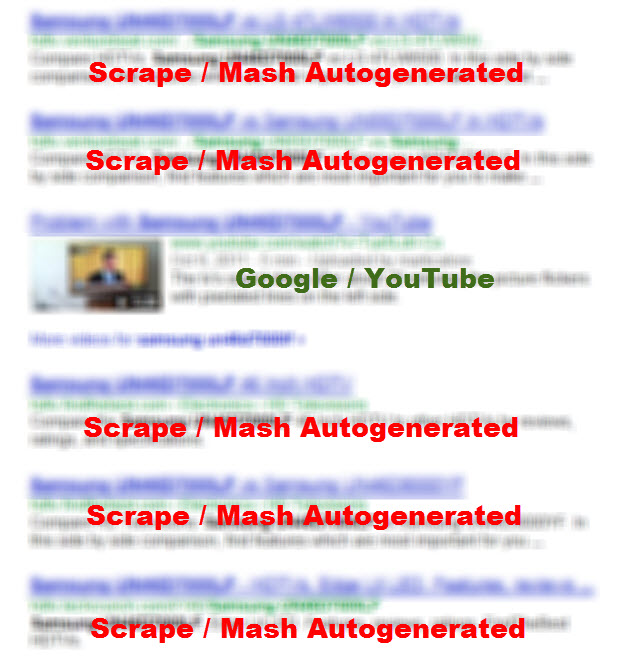
Recently a start up that launched a couple years ago decided to take their thousands of subdomains of scraped databases & partner with authoritative websites to syndicate that content around the web. Some of those get double listings & for some search queries there is the same page (with a different masthead logo) 5 different times. Those sites don't get hit by duplicate content filters or algorithms like Panda because they have enough domain authority that they get a free pass. Including AdSense in the set up probably makes it more palatable to Google as well.
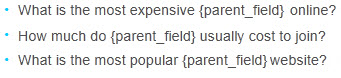
If you have scale you can even auto-generate a bunch of "editorial" questions off the database.
More data = more pages = more questions and comparisons = more pages = SEO alchemy (especially if you don't have to worry about Panda).
The parent scraper site includes links back to itself on every syndicated page, which to some degree makes it a glorified PageRank funnel. WPMU.org got smoked for syndicating out a sponsored theme on one of his own sites, but the above industrial-scale set up is somehow reasonable because it was launched by a person who sold their first start up to Google (and will likely sell this start up to Google too). The site also includes undisclosed affiliate links & hands out "awards" badges to the best casual encounter sex dating sites, which then get syndicated around the web & get it many inbound links from "high quality" porn sites.
I won't name the site here for obvious reasons, but they are not doing the above in a cloak of darkness that one has to look hard to find & do deep research to patch together. For some search results they are half or more of the search result set & they even put out press releases when they add new syndication partners, linking to numerous new automated subdomains or sections within sites related to various categories.
When the search results look like that, if you do original in-depth reviews that are expensive there is zero incentive structure to leaving your content and ratings open to Google and these sort of scraper/syndicaters.
There is always a new spin on the mash up low end content with high trust websites and try to feed it into Google. So long as Google biases their algorithms toward big brands & looks the other way when they exploit the ecosystem that trend will not end.
The Independent Publishers Group, a principal distributor of about 500 small publishers, recently angered Amazon by refusing to accept the company?s peremptory demand for deeper discounts. Amazon promptly yanked nearly 5,000 digital titles. Small-press publishers were beside themselves. Bryce Milligan of Wings Press, based in Texas, spoke for most when, in a blistering broadside, he lambasted Amazon, complaining that its actions caused his sales to drop by 40 percent.
However, even when companies are brutal in some aspects they do amazing things in other areas, so one has to weigh the good with the bad.
At any point Google can fold one vertical into another or extend out a new model. The Android Marketplace feeds into Google Play, Google local feeds into Google+, Google search force feeds just about everything else & even free offerings on sites like YouTube will eventually become pay to play stores.
Where Google lacks marketshare & forced bundling isn't enough to compete they can buy the #2 or #3 player in the market & try to propel it to #1 using all those other forms of bundling.
Part of what made search competitive against other platforms was its openness & neutrality. But if the search results are Wal-Mart over and over again (or the same scraped info 5 times in a row, or a collection of internal listings) then the system becomes more closed off & the perception of choice becomes an illusion. John Andrews wrote a couple greatTweets expressing the shift in search:
"Google SEO is no longer worth the effort for those who are not writers, artists, speakers, trainers, or promoters. What happened to Search?"
"If you want to see what Google will look like after it locks up, look at Apple. ipad users are already "managed" very tightly."
When companies try to expand the depth of their platform with more features it is a double edged sword. At some point they capture more value than they create and are no longer worth the effort. When they get to that stage it becomes a race to the bottom with scrapers trying to outscrape one another. Then in turn the company that created the ecosystem problem uses the pollution they rewarded to further justify closing off the system, guaranteeing only more of the same. Those who actually add value move on looking for greener pastures.
A label or an interest is a vector for ad targeting. There is no need to worry about de-anonymizing data for ad targeting when it is all in-network and you monitor what someone does, control which messages they see, & track which ones they respond to. Tell someone something often enough and they may believe it is true.
The Contempt Large Companies Have for their Customers
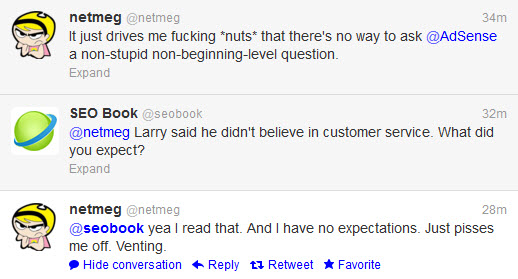
There is a sameness to customer service from a lot of big companies. They spend loads & loads to track you and market to you, but then disappear the moment things go wrong, as they are forbidden to care.
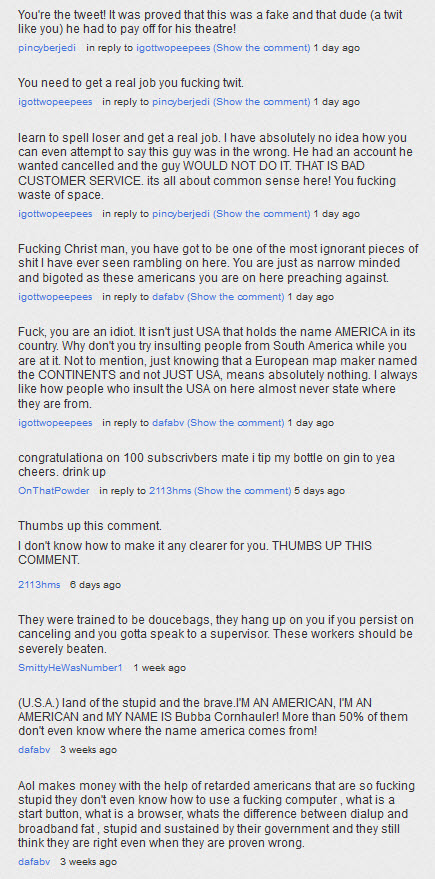
Perhaps the only thing worse that AOL's customer support is the unmoderated comments on the YouTube page.
Denise Griffin, the person in charge of Google?s small customer-support team, asked Page for a larger staff. Instead, he told her that the whole idea of customer support was ridiculous. Rather than assuming the unscalable task of answering users one by one, Page said, Google should enable users to answer one another?s questions.
Even their official blog posts announcing that they are accepting customer feedback for your applications go unmoderated.
This sort of contempt exists at essentially all large companies.
Everything seems on the up & up, but that "private listing" was maybe for a counterfeit product. If it isn't a counterfeit & you get too good of a price you are threatened with a lawsuit, and the branded network falls behind a "oh we are just a marketplace and can't be bothered to give a crap about our customers" public relations angle.
The Retina MacBook is the least repairable laptop we?ve ever taken apart: unlike the previous model, the display is fused to the glass?meaning replacing the LCD requires buying an expensive display assembly. The RAM is now soldered to the logic board?making future memory upgrades impossible. And the battery is glued to the case?requiring customers to mail their laptop to Apple every so often for a $200 replacement. The design may well be comprised of ?highly recyclable aluminum and glass??but my friends in the electronics recycling industry tell me they have no way of recycling aluminum that has glass glued to it like Apple did with both this machine and the recent iPad. The design pattern has serious consequences not only for consumers and the environment, but also for the tech industry as a whole. ... Every time we buy a locked down product containing a non-replaceable battery with a finite cycle count, we?re voicing our opinion on how long our things should last. But is it an informed decision? When you buy something, how often do you really step back and ask how long it should last? If we want long-lasting products that retain their value, we have to support products that do so.
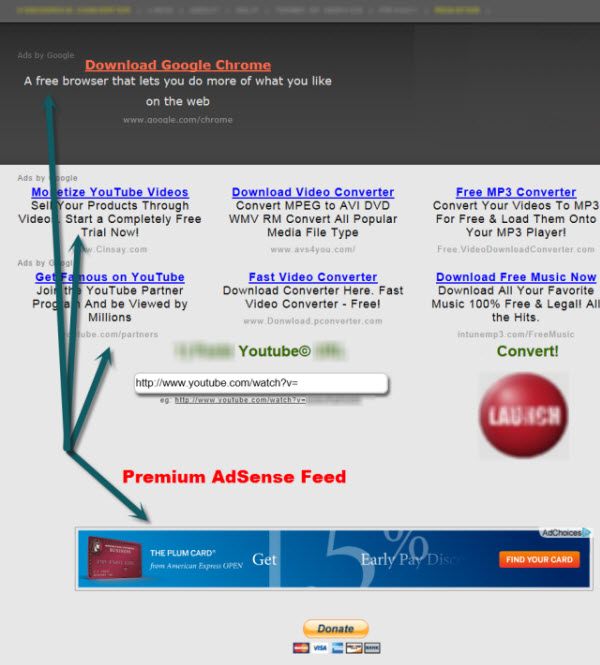
One last bit of absurdity on the YouTube front. Google recently threatened to sue a site designed to convert YouTube videos into MP3s.
How does Google's "computers deserve free speech rights" & shagging 3rd party content to fill out their own vertical search services compare against their approach when someone uses YouTube content in a way Google does not desire?
There are AdWords ads promoting free unlimited MP3 downloading & song burning bundled with shady adware.
Google's AdSense for domains funds boatloads of cybersquatting. While Google threatened to sue this particular site, they could have just took the domain due to it cybersquatting on the YouTube trademark. The fact that they chose to turn this into a press event rather than simply fix the issue shows that this is more for posturing.
Further aligned with the above point, while Google singled out a specific MP3 conversion site, there are other sites designed around doing the same exact thing which are PREMIUM ADSENSE PARTNERS, with the body of the page looking like this:
How Small Companies Are Taxed With Uncertainty
When Google decided to move away from direct marketing to brand advertising things that are often associated with size, scale & brand recognition became relevancy signals.
how much to invest in marketing, where to invest it, how to balance the need for short term cashflow with the required reinvestments to build real (or fake) brand signals
how long does the market have left before Google enters the niche and destroys the opportunity that organic SEO once represented
should you run 1 website, or many to hedge risks? and how many is optimal?
how big should your site be?
if one of your sites gets penalized, should you try to fix it up, should you start over with a new site, or should you consider SEO to be a pointless goal?
Google mentions that they want people to do what is best for the user & not worry about Google, but that advice is a recipe for pain
If you do not run a large & authoritative website there are so many landmines to trip over with the increasing complexity of SEO. And any of Google's "helpful" webmaster messages can suspend a webmaster in fear, leading them to an eventual bankruptcy.
Small companies need to do all sorts of canonicalization hoops & prune content and such to hope to avoid algorithms like Panda. Then Google changed their host crowding preferences to let some large sites get up to 8 listings in a single search result page for their LACK OF effort. Those larger sites can then partner with glorified scraper sites that syndicate databases feeding on domain authority with no risk of Panda.
Due to how Google penalizes smaller sites, those that rewrite their content will outrank them when they get hit. These horrible trends are so obvious that even non-SEOs like Tim Carter (who was a Google golden boy for years) highlights how the tables have tilted away from what is most relevant to what pays Google the most.


 Tham gia cùng 10 triệu người.
 Chat ngay
 Di động